

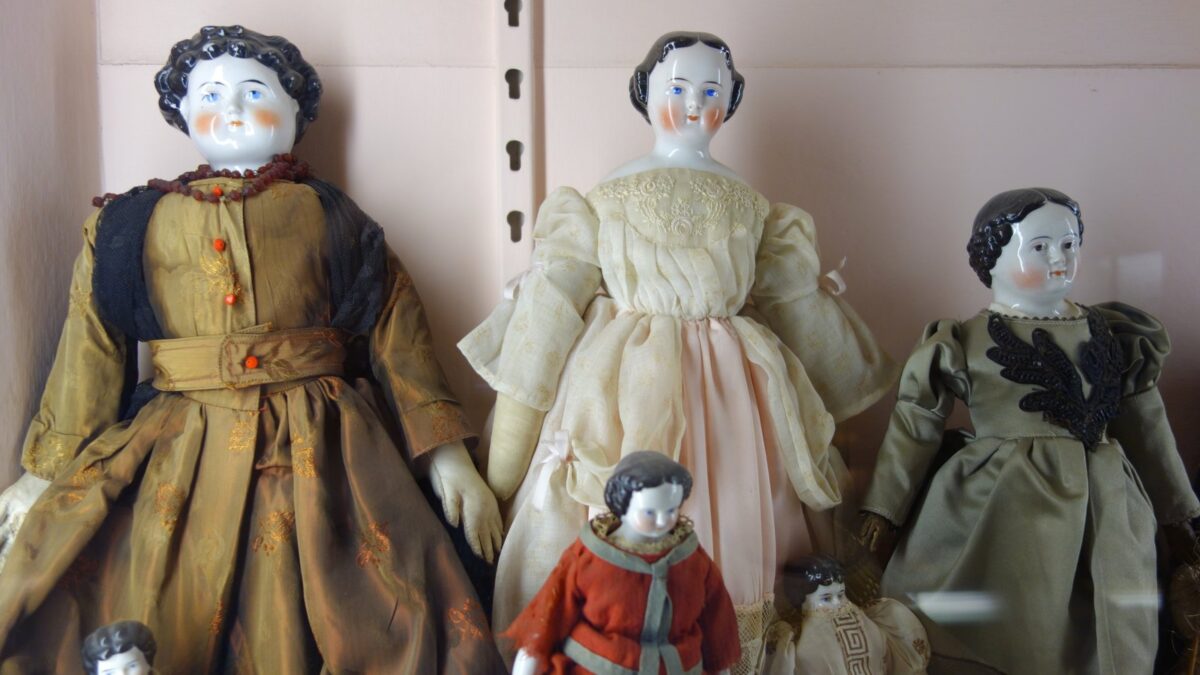
An antique china doll has a head of glazed porcelain, shiny like a dinner plate, usually sewn onto a cloth or leather body. Almost all of them came from German factories between about 1840 and 1930.
Dating one is an exercise in narrowing ranges. Hairstyle, glaze color, face shape, body and marks each give a clue, and museum catalogs rarely commit to anything closer than a decade.
Dolls are far older than porcelain, as our search for the first doll ever made shows. China heads belong to a later story, one of factory molds, export catalogs and mothers sewing bodies at home.
China Versus Bisque in One Minute
China and bisque are the same porcelain at different finishes. China is glazed and glossy, while bisque is left unglazed and has a matte, skin-like surface.
Bisque, the French makers who perfected it, and Jumeau in particular are covered in our history of dolls. This guide stays with the glossy heads.
Even museums mix the terms. The V&A’s doll “Susie,” dated about 1868, is titled “Doll with bisque head” in its summary line, yet the same record describes a “moulded glazed china shoulder head.”
Where Antique China Doll Heads Came From
Thuringia and the export trade
The Strong National Museum of Play traces most 19th-century doll heads to German potteries that also made vases, dishes and figurines. Its blog places them in Thuringia, where a large ceramic industry was already running.
According to the Strong, German manufacturers exported the first doll heads in the 1840s. Heads were sold in many sizes and often bought on their own by mothers who made the bodies.
The makers museums actually name
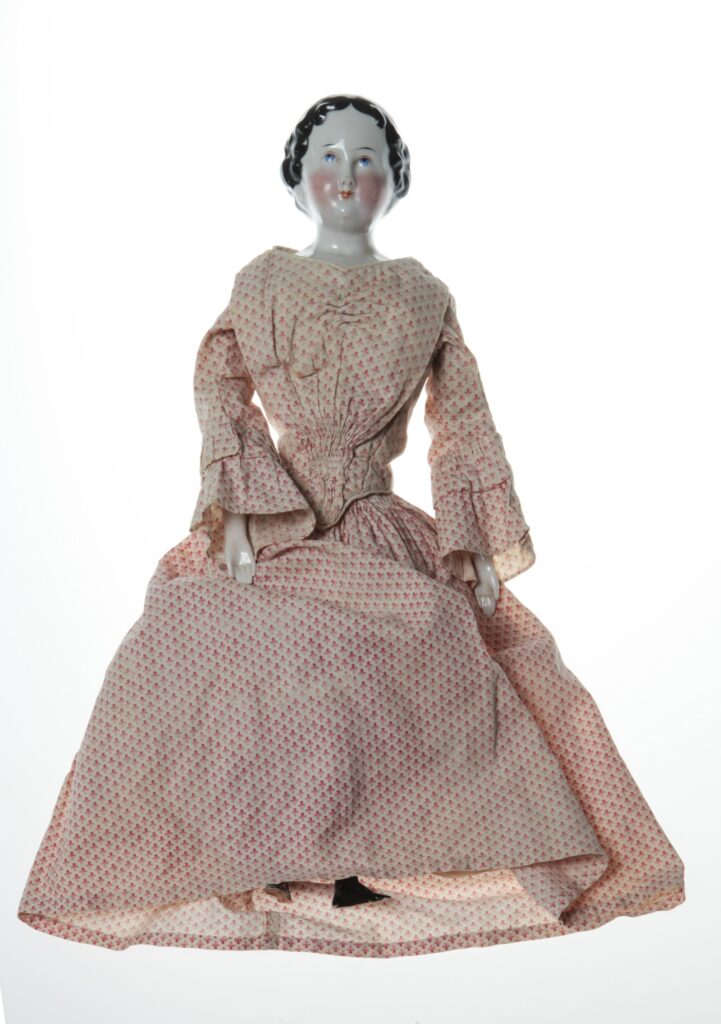
Most china heads carry no maker’s mark, so attributions are rarer than dealer listings suggest. Hertwig & Co. is the firm that museum records name most often.
The V&A credits Hertwig with a doll called “Ethel” from its Pet Name series, made from 1895 onward. The Illinois State Museum says Hertwig “likely made” a china doll recovered from a farmstead cistern, matched to Butler Brothers catalogs of 1895 and 1905.
Collector references also list Kestner, Conta & Boehme and Alt, Beck & Gottschalck as china-head makers. We found no museum catalog record crediting those three firms with a specific glazed head. Kestner’s museum-documented work in this period includes the first bisque Kewpie dolls of 1913.
The Strong credits much modern attribution to the researcher Mary Gorham Krombholz. She searched old factory sites in Germany for shards, then matched them to unmarked dolls.
How Do You Date an Antique China Doll?
You date an antique china doll by combining several clues: hairstyle, glaze tint, face and neck shape, body construction and any marks. No single clue settles it, and museum dates are ranges built from the same evidence.
Hairstyle is a collector convention
Doll makers copied fashionable hair, so the hairdo is the first thing curators check. The Strong puts the method and its limit in a single sentence.
“German makers began china-doll production around 1840 and continued until about 1930, but curators often could figure out the approximate age of a doll by its hairdo.”
Patricia Hogan, The Strong National Museum of Play, 2010
Collectors use nicknames such as “covered wagon,” “flat top” and “low brow” for recurring styles. Treat these as trade shorthand rather than museum categories, because molds stayed in use long after a fashion passed.
Museum records mostly describe the hair instead of naming it. The table below shows how the V&A pairs hair and tint with its date ranges.
| V&A record | Museum date | Glaze | Hair as described |
|---|---|---|---|
| T.13-1939 | 1840–1850 | Pink | Centre parting, braids in a circle held by a comb |
| B.243-1997 | 1840–1850 | Pale pink tinge | Human hair in a low braided bun |
| T.113-1929 | About 1855 | Very pale pink | Waved at front, braids with knot at back |
| MISC.21-1938 | About 1865 | Pink | Waved, short ringlets at back |
| MISC.69-1966 | 1880 | White | Moulded black hair |
| MISC.410-1987 | 1895–1920 | Not stated | Black “low brow” style |
Pink tint versus white
In those records, every pink-tinted head falls between the 1840s and the 1860s. The one later head with a stated glaze color, dated 1880, is white.
That matches the collector rule that pink tint suggests an earlier head. Five records with a stated tint make a pattern, though, and they cannot serve as proof.
Face, neck and body
The Strong says that by the 1880s, makers produced heads with shorter, wider necks, fuller faces and big eyes. The earlier heads depicted graceful women with fashionable hair.
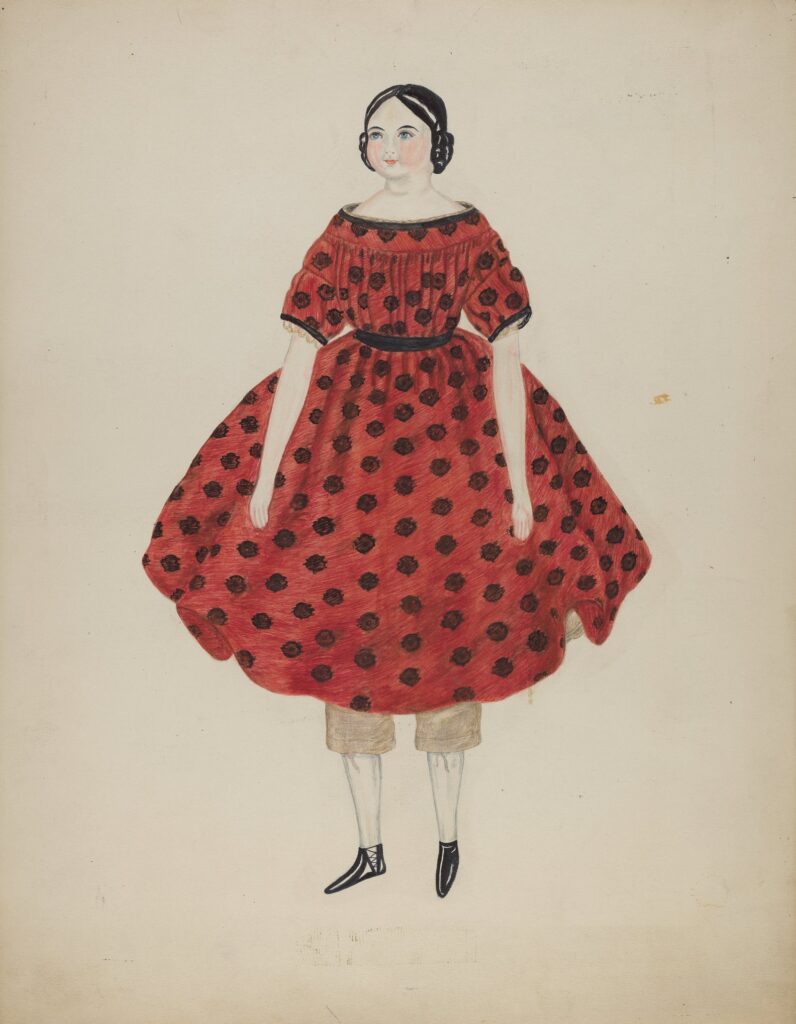
Bodies vary widely because so many were homemade. The V&A’s “Susie” has a stuffed cloth body with black leather arms. Seven dolls at Sudbury Hall, dated about 1900 to 1920, combine china heads with calico bodies and bisque lower legs painted as brown boots.
A replaced body does not make a head a fake, since many bodies were home-sewn from the start. Date the head and the body separately, and describe the doll as a marriage if they disagree.
Marks, and Why Most Heads Have None
The Strong says most china dolls lacked manufacturers’ marks, which kept the makers a mystery. The marks that do appear are usually small and hard to read.
- Numbers and letters. The V&A records an incised “9” on a back plate, “M or W” scratched inside another head, and “X over an elongated hook.”
- Country of origin. The Sudbury Hall dolls carry “9/ Germany” on the back of the shoulder head.
- Names. Hertwig’s “Ethel” has her name moulded on the front shoulder plate and “PATENT APPD FOR // GERMANY” on the back.
A number usually indicates size or mold, not maker. An unmarked head can still be genuine, and most are.
Reproductions and Later Porcelain Heads
Porcelain doll heads did not stop in 1930. The V&A holds plaster molds and cast heads that Royal Doulton produced in 1982 for limited-edition heirloom dolls.
Wear is one check, though not a decisive one. The V&A calls its china head dug from an English garden “surprisingly good” in condition, adding that buried heads usually have badly affected glaze.
Read museum date qualifiers with the same care you read marks. Our guide to the oldest plush in museum records explains why “about” and “possibly” carry weight.
Where the Record Disagrees
The V&A says glazed china dolls were made “for about 70 years, primarily in Germany.” The Strong gives a span of roughly 1840 to 1930, closer to 90 years.
The gap probably reflects different end points rather than a factual dispute. Small, cheap china dolls kept selling after fashionable ones faded, as the Sudbury Hall examples of 1900 to 1920 suggest.
Attribution is the larger uncertainty. Even the Illinois State Museum writes “likely” for Hertwig, and that hedge is the honest default for any unmarked antique china doll.
Sources
- The Strong National Museum of Play, Patricia Hogan, “The Curious Case of the China Doll,” 2010, museumofplay.org.
- The Strong National Museum of Play, “Doll,” Hertwig & Co., via Google Arts & Culture, artsandculture.google.com.
- Victoria and Albert Museum, Doll “Susie,” about 1868, MISC.171-1976, collections.vam.ac.uk.
- Victoria and Albert Museum, Doll’s head, 1840–1850, T.13-1939, collections.vam.ac.uk.
- Victoria and Albert Museum, Doll’s head, 1840–1850, B.243-1997, collections.vam.ac.uk.
- Victoria and Albert Museum, Doll’s head, about 1855, T.113-1929, collections.vam.ac.uk.
- Victoria and Albert Museum, Doll’s shoulder head, about 1865, MISC.21-1938, collections.vam.ac.uk.
- Victoria and Albert Museum, Doll, glazed porcelain, 1880, MISC.69-1966, collections.vam.ac.uk.
- Victoria and Albert Museum, “Ethel,” Hertwig & Co., MISC.410-1987, collections.vam.ac.uk.
- Victoria and Albert Museum, Miniature glazed china doll’s head, B.13-1998, collections.vam.ac.uk.
- Victoria and Albert Museum, Head mould for heirloom dolls, Royal Doulton, B.147:1-2000, collections.vam.ac.uk.
- National Trust Collections, Glazed china-headed doll, Sudbury Hall, NT 659685, nationaltrustcollections.org.uk.
- Illinois State Museum, “Porcelain ‘China’ Doll Head,” story.illinoisstatemuseum.org.
Comments (0)