
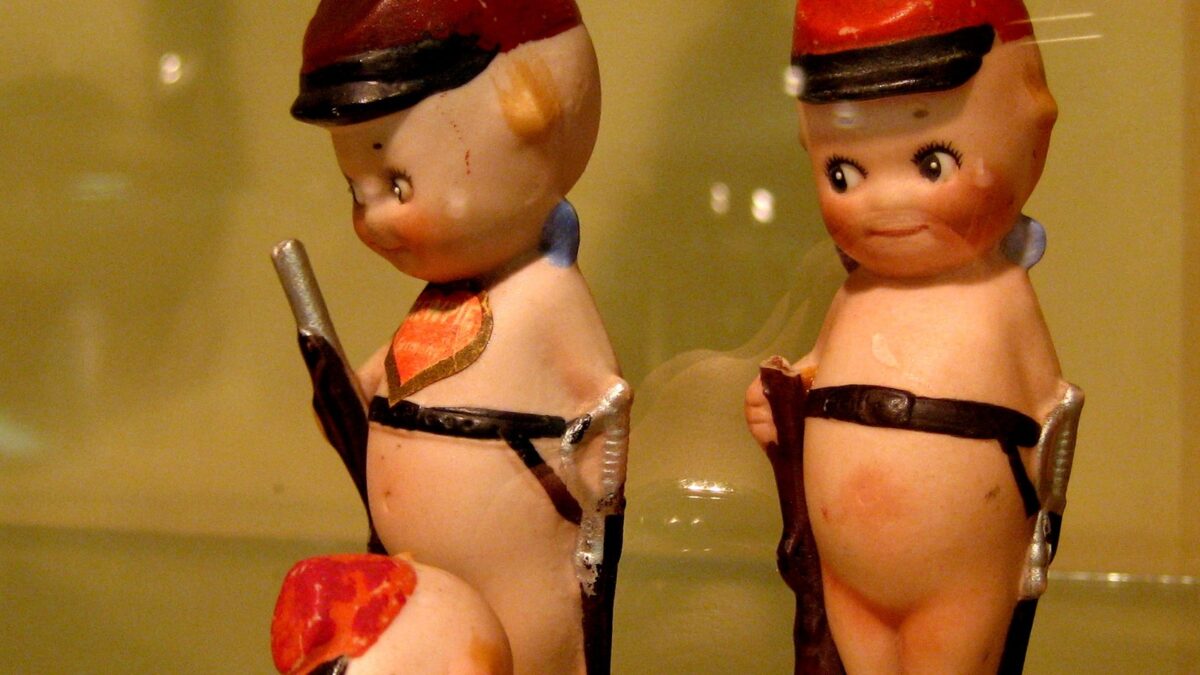
An antique Kewpie doll is usually a small German bisque figure made from 1913 onward to Rose O’Neill’s patented design. The earliest ones carry marks that later celluloid, composition and vinyl Kewpies lack.
Those marks are the reason this guide exists. Museum records in London and Thuringia describe exactly what an early Kewpie should show, and the patent behind them is public.
Kewpies sit in an odd gap in doll history. They arrived two years before the Raggedy Ann design patent covered in our history of dolls, yet they began as magazine drawings, not toys.
From Magazine Page to Bisque Figure
The 1909 comic
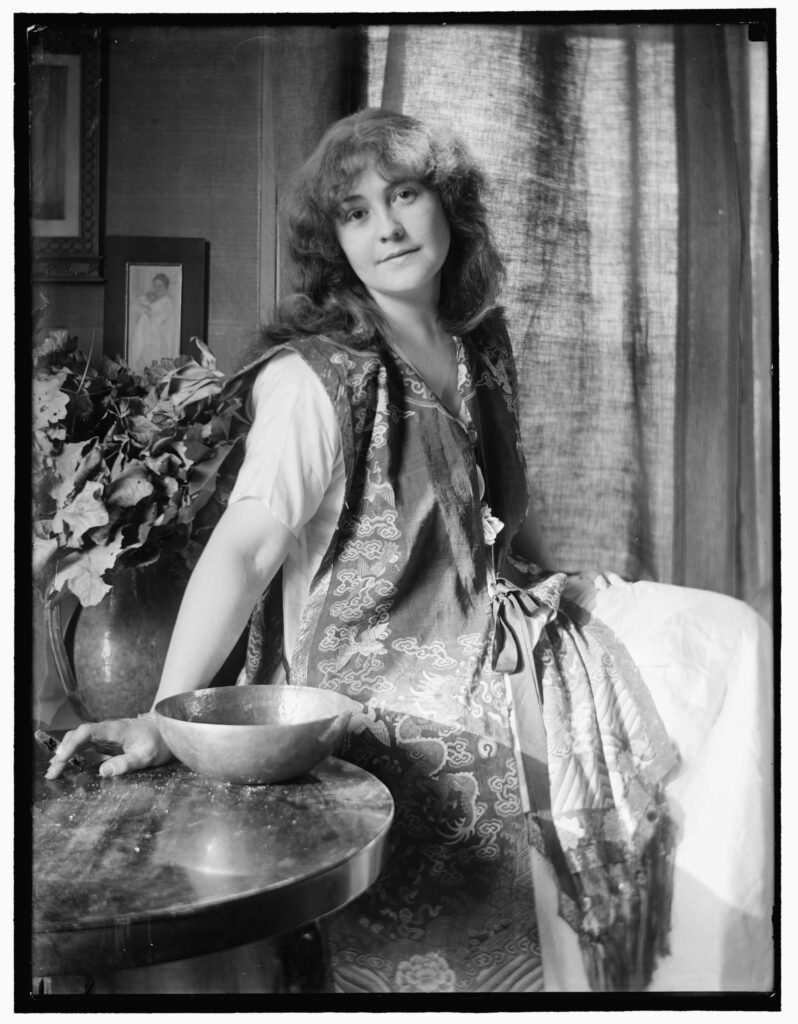
Rose O’Neill was already a working illustrator when the Kewpies made her famous. The Library of Congress says her comic “The Kewpies” premiered in Ladies’ Home Journal in 1909 and was an instant hit.
The characters were round-bellied cupids who did good deeds in a humorous way. O’Neill had been developing them since 1907, according to the same Library of Congress essay.
The 1913 design patent
O’Neill filed for a design patent on December 17, 1912. The U.S. Patent Office granted it on March 4, 1913, as Design No. 43,680, titled simply “Design for a doll.”
The patent names the inventor as Rose O’Neill Wilson of Day, Missouri, and shows a front and a rear view. Searching Google Patents under “Kewpie” alone will miss it, because the word does not appear in the title.
Made in Ohrdruf
German porcelain makers, the same Thuringian industry behind the antique china doll, turned the drawings into figures. The V&A dates its all-bisque Kewpie to 1913 and credits J. D. Kestner as manufacturer, with O’Neill as designer.
Museum Schloss Ehrenstein in Ohrdruf, Kestner’s home town, agrees on the year. Its catalog says Kestner & Co first produced the bisque Kewpies in 1913, shortly after O’Neill patented her figures.
Demand was immediate. A Washington Times headline from November 30, 1913, quoted by the Library of Congress, read: “Kewpie doll, latest ‘sending,’ makes the world shake with laughter.”
How Can You Tell a Real Kewpie Doll?
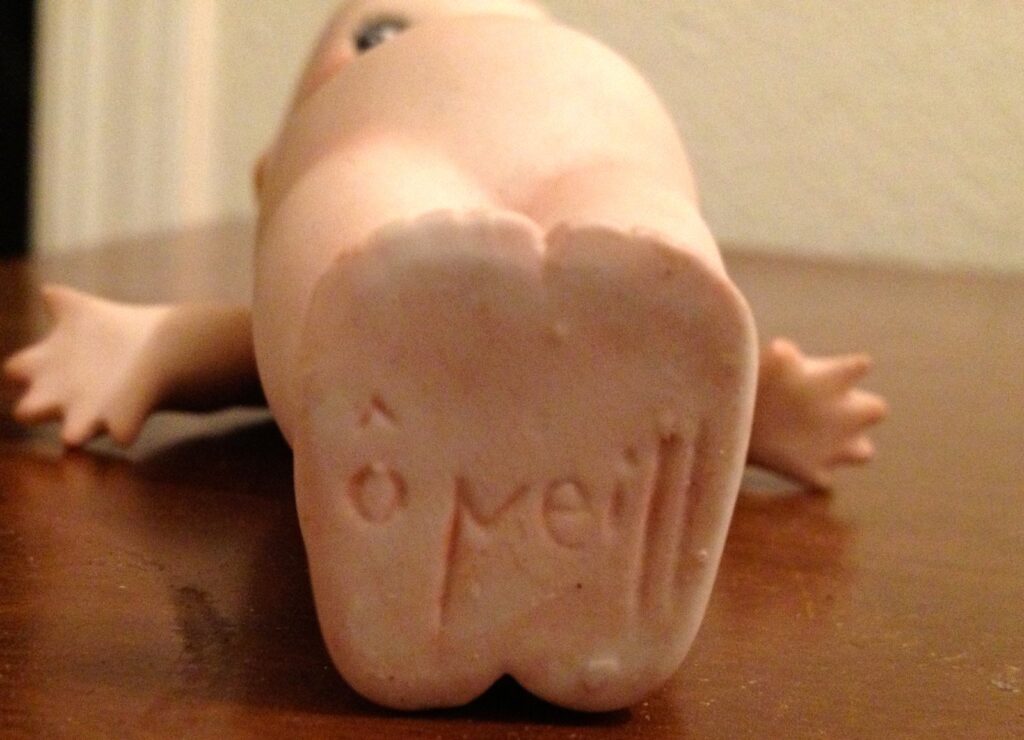
A real early Kewpie is all bisque, made in Germany, and usually marked in at least one of three places. Look for a paper heart on the chest, a round paper label on the back, and O’Neill’s name incised under the feet.
Paper labels wash off and feet get chipped, so one missing mark proves little. Several marks together, on the right material, make a much stronger case, the same logic that sorts Raggedy Ann’s maker eras.
The heart on the chest
The Ohrdruf museum describes a standing Kewpie with a red heart-shaped label glued to its chest. The label reads “KEWPIE Germany.”
The round label on the back
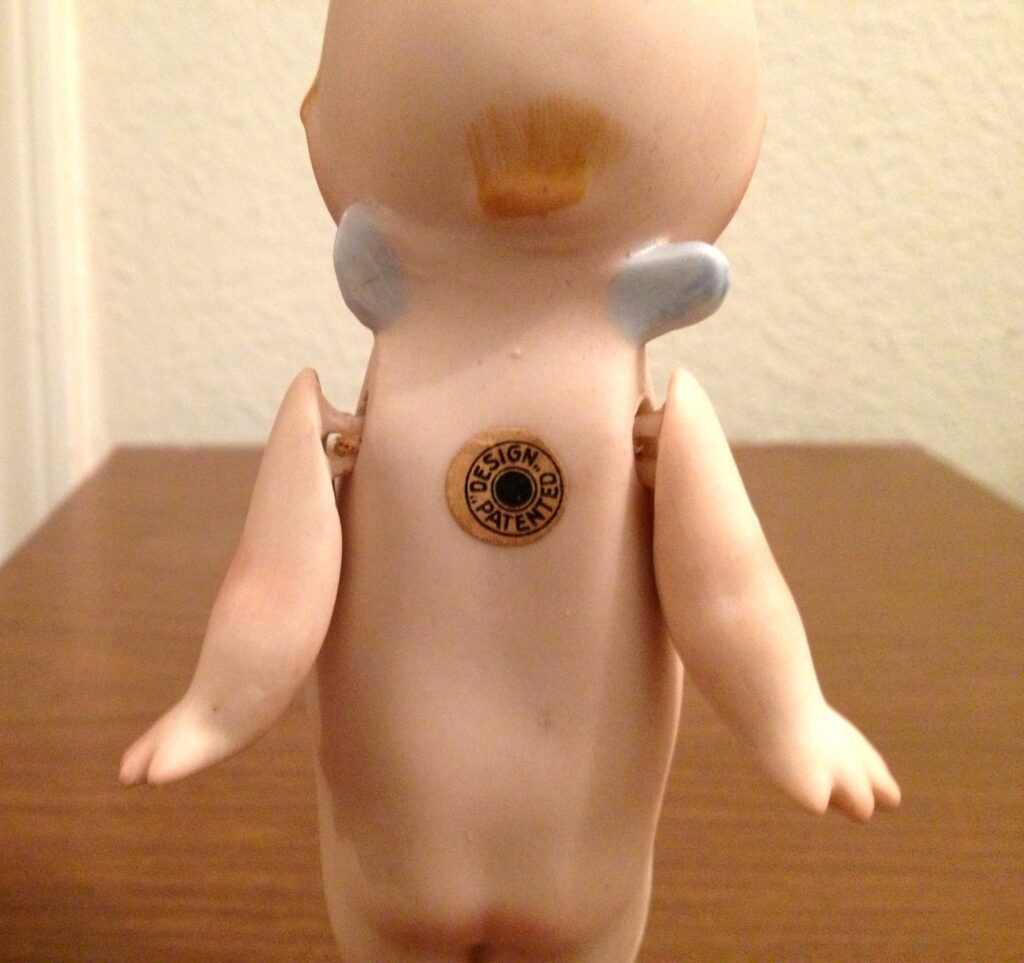
The same record notes a small round copyright label on the back, crediting Rose O’Neill. Other surviving examples carry a round “Design Patented” sticker in the same spot, as the photograph below shows.
The signature under the feet
The museum’s seated “Thinker Kewpie” carries the incised abbreviation “O’Neill” on its underside. On standing figures, collectors look for the name scratched into the soles.
Wings, hair and pose
Every Ohrdruf example has small blue wings at the sides of the neck. The records also note tiny blond hair swirls on top of the head and behind the ears.
The museum lists the “Standing Kewpie” and the “Thinker Kewpie” among the first figures designed for production. Novelty versions followed, including a gardener with a straw hat and a Kewpie in a wicker chair.
“Many were hand signed by O’Neill and stamped with a heart-shaped mark. Cheaper un-marked alternatives were produced in Japan and were made of celluloid rather than bisque.”
Victoria and Albert Museum, catalog note for All-bisque Doll, MISC.18-1974
Check the material before the marks. Bisque feels cool, heavy and slightly chalky, while celluloid is light and warms quickly in the hand. A celluloid Kewpie with a heart label is still a later piece, whatever the seller calls it.
Antique Kewpie Doll Materials, From Bisque to Vinyl
Later Kewpies are collectible in their own right, but they are a different purchase. The table below sorts them by the material collectors check first.
| Material | Era in the records | Typical maker | Marks to expect |
|---|---|---|---|
| Bisque (unglazed porcelain) | From 1913 | J. D. Kestner and other German firms | Heart label, round back label, incised O’Neill |
| Celluloid | Undated in V&A note | Japanese makers | Often unmarked, per the V&A |
| Composition | 1920s | American makers, including Cameo | Heart label with O’Neill copyright |
| Vinyl | Later 20th century | Later licensees | Molded marks; check the licensee |
The composition era ties back to one man. Joseph Kallus, who worked with O’Neill on turning her drawings into dolls, founded the Cameo Doll Company in New York in 1922, according to the Heinz History Center.
Patent numbers help date any of these. Our profile of toy inventor Eddy Goldfarb shows the same habit of matching a number on a toy to its Google Patents record.
Where the Kewpie Record Disagrees
Sources do not fully agree on when the dolls reached shops. The Lemelson-MIT Program says German bisque Kewpies hit the international market in 1912, while the V&A, the Ohrdruf museum and the Library of Congress all point to 1913.
The patent supports the later date. Filing in December 1912 and receiving a grant in March 1913 suggests 1913 production, though samples could have existed earlier.
The photographer of the signed foot shown above describes that doll as made in 1912. We report the claim as given, but no museum record we checked dates a production Kewpie earlier than 1913.
- 1907 O’Neill begins drawing the cupid characters, per the Library of Congress.
- 1909 “The Kewpies” premieres in Ladies’ Home Journal.
- December 17, 1912 O’Neill files her doll design patent.
- March 4, 1913 Design No. 43,680 is granted.
- 1913 Kestner & Co produces the first bisque Kewpies in Ohrdruf.
- November 30, 1913 The Washington Times reports the Kewpie craze.
- 1922 Joseph Kallus founds the Cameo Doll Company in New York.
None of this sets a price. Value depends on size, pose, condition and how many original marks survive, and we do not quote figures without a dated sale record. The same label-first habit we recommend for spotting fake plush brands applies here.
Sources
- Library of Congress, Headlines and Heroes blog, “Rose O’Neill: Artist, Activist, and Queen of Kewpies,” 2020, blogs.loc.gov.
- U.S. Patent Office, Rose O’Neill Wilson, Design for a Doll, USD43680, 1913, patents.google.com.
- Victoria and Albert Museum, All-bisque Doll, J. D. Kestner, 1913, MISC.18-1974, collections.vam.ac.uk.
- Museum Schloss Ehrenstein Ohrdruf, “Kewpie, stehend (Standing Kewpie),” thue.museum-digital.de.
- Museum Schloss Ehrenstein Ohrdruf, “Kewpie, sitzend (Thinker Kewpie),” thue.museum-digital.de.
- Museum Schloss Ehrenstein Ohrdruf, “Kewpie, stehend (Gärtner Kewpie),” thue.museum-digital.de.
- Lemelson-MIT Program, “Rose O’Neill,” lemelson.mit.edu.
- Senator John Heinz History Center, Cameo Doll Company, heinzhistorycenter.emuseum.com.
Comments (0)