
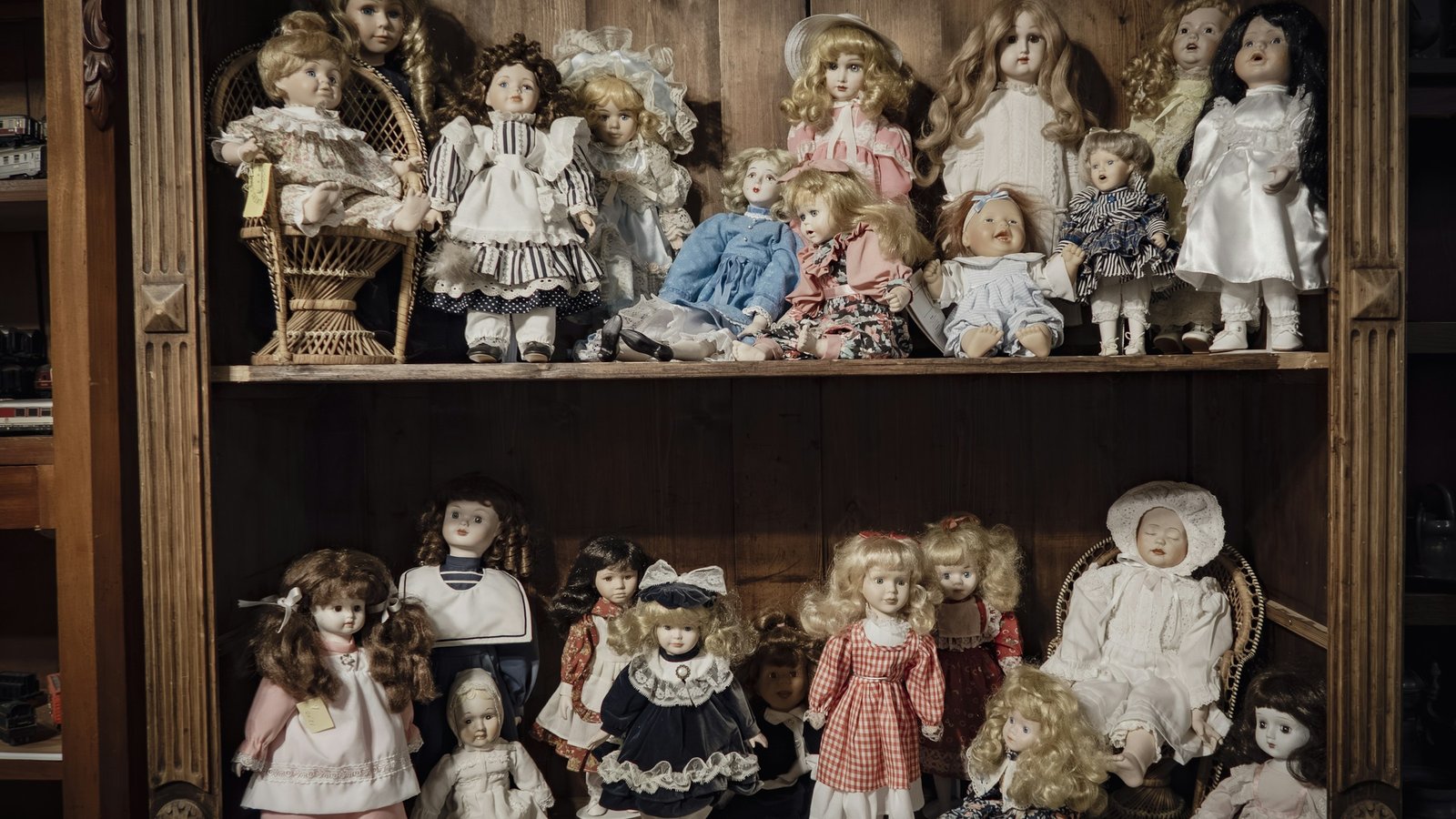
The history of dolls is mostly a history of materials. Clay gave way to carved wood, then to poured wax, fired bisque, stuffed cloth, and finally molded plastic.
Each change altered who could own a doll and what it was for. Some dolls taught fashion, and some were never toys at all.
This guide traces doll history through objects at the Metropolitan Museum of Art and the V&A, plus American patent and sales records. The search for the first doll ever made gets its own article. Here, the story starts with dolls whose purpose we can document.
What Counts as a Doll in History?
In museum practice, a doll is a small human figure made to be handled, dressed, or displayed, usually by a child. The line between a doll and a ritual figure is often unclear. Curators mark that doubt openly, sometimes by putting the word “doll” in quotation marks.
The Met does exactly that with a Greek terracotta figure from the late 5th or early 4th century BCE. Its catalog title reads: Terracotta limbless “doll.” The note adds that its limbs “were never added,” so we cannot tell whether it was finished as a toy.
Pueblo katsina figures show the opposite problem. The Met’s record for a Zuni Hiilili figure from about 1900 says such carvings are given to young girls during ceremonies. The figures then hang in their homes.
Outsiders later called them “kachina dolls.” The Met says makers began producing them for the outside market in the late 19th century.
Doll History in the Ancient Greek World
Jointed clay figures with movable limbs
Greek workshops made terracotta figures with arms and legs attached by string through drilled holes. They look like toys to a modern eye. The Met’s Corinthian example from the 5th century BCE is 12 centimeters tall and still has its jointed limbs.
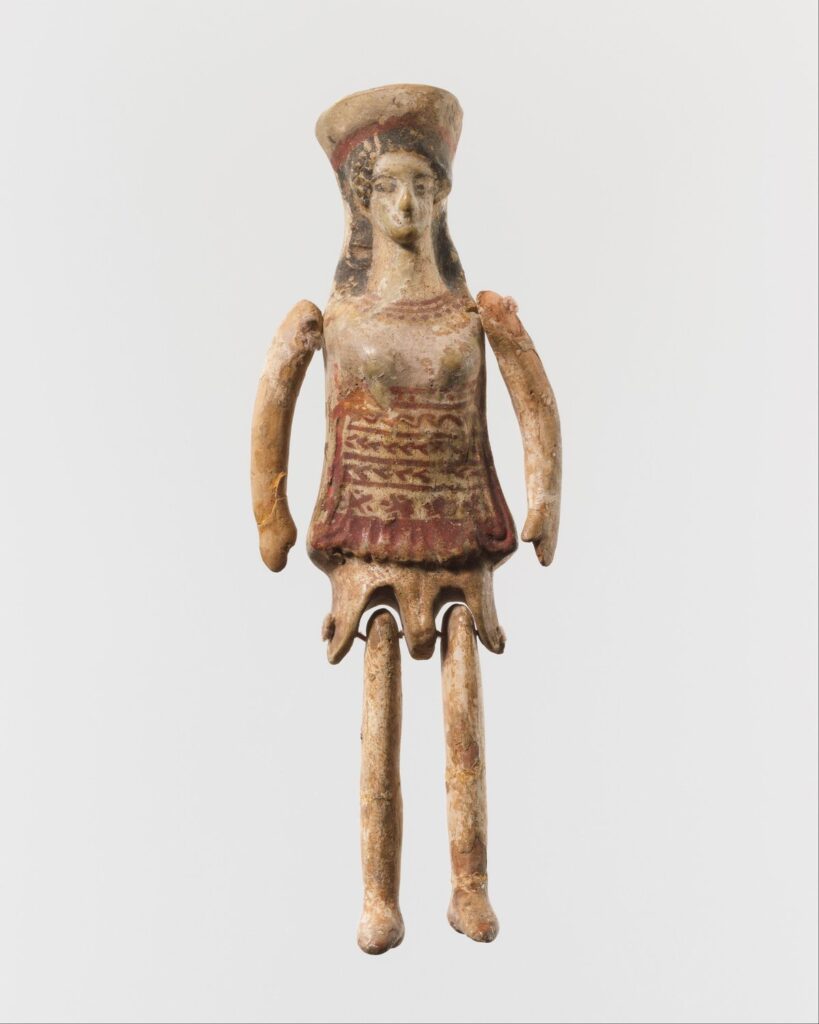
Its catalog note pushes back on the toy reading. The Met says many jointed figurines were found in sanctuaries, burials, and terracotta workshops. Their tall headdress and short tunic suggest ritual dancers.
A small hole in the head shows it was meant to hang. That detail fits an offering or a charm better than a plaything dragged around by a child.
Why the toy question stays open
Both readings can hold at once. A figure could be made for a sanctuary and still end up in a child’s hands, or the reverse.
For collectors and historians, the practical rule is to follow the museum’s wording. When a catalog says “doll” in quotation marks, it is telling you the evidence stops short of proof.
Seeing these objects takes planning. In October 2026, the limbless “doll” was on view in the Met’s Gallery 159, but the Corinthian figure was not. Our teddy bear museum guide applies the same check-first habit to bear collections.
Wooden and Fashion Dolls, 1690 to 1750
Lord and Lady Clapham at the V&A
The V&A holds a pair of English wooden dolls made in London between 1690 and 1700. Known as Lord and Lady Clapham, they are thought to have belonged to the Cockerell family, descendants of the diarist Samuel Pepys.
Lord Clapham has a turned-wood body, jointed legs hinged at the knee and thigh, and human hair nailed to the head. His wardrobe matters more than his body. The museum calls the pair “costume documents,” because their clothes are exact miniatures of late 17th-century fashion.
Few real garments survive from the 1690s. Dolls like the Claphams fill that gap in costume history. On an early wooden doll in original clothes, the clothing may matter more to historians than the carving.
An English fashion doll sent to America
Fashion dolls carried the latest silhouettes from dressmakers to customers. The Met owns one made in England around 1748, which probably reached the American colonies as a girl’s plaything.
“Dolls like this served two purposes—as both toys and advertisements of the latest fashion.”
The Metropolitan Museum of Art, catalog entry for Doll in a box, about 1748
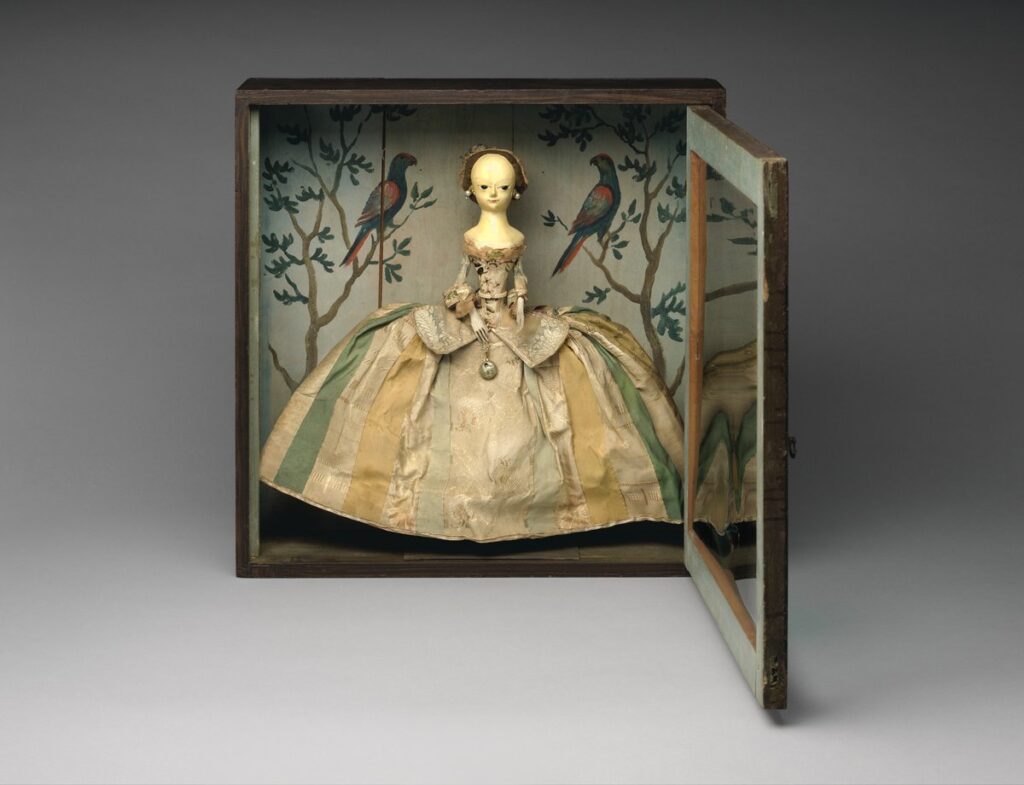
The doll wears two petticoats, metallic-ribbon shoes, pearl earrings, and a watch. The Met notes she was “never meant to be undressed like modern day dolls.” Someone in America later built her a painted shadow box to keep her safe between play sessions.
Wax and Bisque in the Nineteenth Century
Montanari’s royal baby in wax
Poured wax allowed realistic skin tones and fine facial modeling. The Montanari family were among the best-known wax doll makers in Victorian Britain, according to the V&A.
One Montanari doll in the V&A depicts Prince Arthur, Queen Victoria’s seventh child, as a baby. The museum records that it was bought at the Great Exhibition in 1851 for a girl named Sophie, born in 1840.
Jumeau and the French bisque doll
Bisque is unglazed porcelain, and it made the most celebrated dolls of the century. The V&A says the French firm Jumeau began making bisque dolls in the 1840s, first in Paris and later in Montreuil-sous-Bois.
Jumeau exhibited at the Great Exhibition of 1851 and won a first-place medal. The firm peaked in the 1880s, then lost ground to cheaper German manufacturers.
The V&A’s own example shows how hard attribution can be. It labels a small fashion doll from about 1880 as “possibly Jumeau,” because the head carries no company mark. The museum says unmarked heads were fairly usual for these dolls.
Cloth and Fashion Dolls in the Twentieth Century
Raggedy Ann’s 1915 design patent
Stuffed cloth dolls reach back to Roman Egypt, as our history of stuffed animals shows. The 20th century gave them legal owners.
John B. Gruelle of New York filed a design patent for a doll on May 28, 1915. The U.S. Patent Office granted it as Design No. 47,789 on September 7, 1915.
Illinois Public Media calls that date the legal birthday of Raggedy Ann, a rag doll with red yarn hair and button eyes. Origin stories conflict, though most involve Gruelle finding an old homemade rag doll in his parents’ attic. The patent itself shows only the design.
The same decades brought a rival from the toy shelf. Teddy bears arrived in 1902 and 1903, and our teddy bear history records a 1908 sermon against them. A Michigan minister warned that swapping dolls for bears would destroy girls’ maternal instincts.
Barbie’s 1959 debut
Barbie marked the shift from baby dolls to an adult figure. According to the Lemelson-MIT Program, Ruth Handler introduced her at the American Toy Fair in New York City in 1959.
Handler based the design on Lilli, a German doll modeled on a comic-strip character, and named it after her daughter Barbara. Mattel sold 351,000 Barbies in the first year at $3 each, a sales record for the company.
History of Dolls Timeline
The dates below come only from the sources listed at the end. Spans reflect the museums’ own date ranges.
- 5th century BCE Corinthian workshops produce jointed terracotta figures, possibly ritual dancers.
- c. 400 BCE The Met’s limbless Attic “doll” is made, its arms and legs never added.
- 1690–1700 Lord and Lady Clapham are made in London, probably for a family descended from Pepys’s relatives.
- c. 1748 An English fashion doll travels to the American colonies.
- 1840s Jumeau begins making bisque dolls in Paris, per the V&A.
- 1851 Jumeau wins a medal and a Montanari wax baby is sold at the Great Exhibition in London.
- c. 1880 Jumeau’s popularity peaks before German competition grows.
- c. 1900 Zuni makers carve katsina figures, some now sold as “kachina dolls.”
- 1915 John B. Gruelle receives Design Patent No. 47,789.
- 1959 Barbie debuts at the American Toy Fair in New York.
Types of Dolls in History
Doll types overlap, since a bisque doll can also be a fashion doll. The table groups them by the feature collectors use first when sorting a collection.
| Type | Period | Typical materials | Example in this guide |
|---|---|---|---|
| Jointed figure | Ancient Greece | Terracotta, string | Corinthian figurine, 5th century BCE |
| Ceremonial figure | Pueblo cultures, 19th–20th centuries | Cottonwood, pigment, feathers | Zuni Hiilili katsina, about 1900 |
| Turned wooden doll | Late 17th–18th centuries | Wood, gesso, human hair | Lord and Lady Clapham, 1690–1700 |
| Fashion doll | 18th–19th centuries | Wood or bisque, silk | Doll in a box, about 1748 |
| Wax doll | 19th century | Poured wax, cotton, glass eyes | Montanari’s Prince Arthur, 1850–1851 |
| Bisque doll | 1840s–1900s | Unglazed porcelain, kid leather | Possibly Jumeau, about 1880 |
| Cloth doll | 20th century | Fabric, stuffing | Raggedy Ann, 1915 patent |
| Adult fashion doll | 1959 onward | Factory-made, mass-produced | Barbie, 1959 |
Where the Doll Record Is Uncertain
Several claims in this history rest on attribution rather than proof. The museums say so, and so should anyone repeating them.
- Toy or ritual object. The Met suggests its Corinthian jointed figure shows a ritual dancer, not a child’s toy.
- Ownership. The V&A says the Claphams are “thought to have” belonged to the Cockerell family, not that they did.
- Maker. The V&A’s small French fashion doll is only “possibly Jumeau,” since it carries no mark.
- Naming. “Kachina doll” is a market label. The Met describes these carvings first as katsina figures given to girls in ceremonies.
Those caveats point to the real skill in doll collecting. A doll’s value depends on what the paperwork can prove, and the paperwork rarely covers everything a seller claims.
That is why we cite catalog numbers wherever a museum provides them, as our editorial guidelines require. A buyer can check a catalog number, which is more than most seller descriptions allow.
Sources
- The Metropolitan Museum of Art, “Terracotta limbless ‘doll,'” Greek, Attic, 20.205, metmuseum.org.
- The Metropolitan Museum of Art, “Figurine with articulated limbs,” Greek, Corinthian, 44.11.8, metmuseum.org.
- The Metropolitan Museum of Art, “Hiilili Kokko (Katsina Figure),” Zuni, 2018.867.1, metmuseum.org.
- The Metropolitan Museum of Art, “Doll in a box,” about 1748, 53.179.12a, b, metmuseum.org.
- Victoria and Albert Museum, “Lord Clapham,” T.847-1974, collections.vam.ac.uk.
- Victoria and Albert Museum, Doll, Montanari, MISC.311-1985, collections.vam.ac.uk.
- Victoria and Albert Museum, Fashion doll, possibly Jumeau, B.161:1 to 10-2010, collections.vam.ac.uk.
- U.S. Patent Office, John B. Gruelle, Design for a Doll, USD47789, 1915, patents.google.com.
- Illinois Public Media, “September 7: Illinois History Minute,”, will.illinois.edu.
- Lemelson-MIT Program, “Ruth Handler,”, lemelson.mit.edu.
2 thoughts on “History of Dolls, From Greek Clay to the 1959 Barbie”