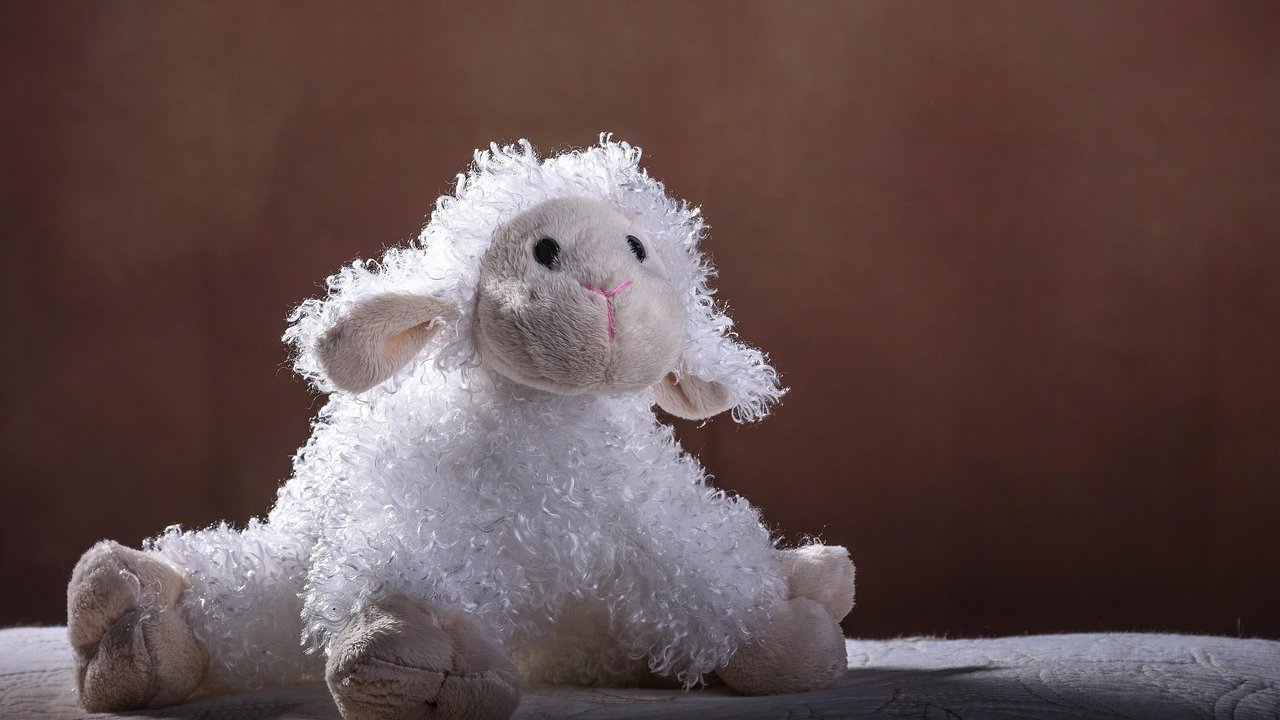
Among stuffed animals, sheep carry a built-in surprise. Many vintage stuffed toy lambs that look woolly are covered in mohair, which comes from goats.
The V&A’s Larry the Lamb, made around 1950, is a good example. Its catalog lists white mohair over a body stuffed with wood wool. This guide covers how collectors sort wool from mohair, which historic lambs survive in museums, and how to date a newer one.
Wool Stuffed Animals and What the Label Means
Wool, in everyday speech, means sheep’s fleece. Mohair is different. The University of Massachusetts Amherst agricultural extension states that Angora goats produce mohair, while the fiber called angora comes from rabbits.
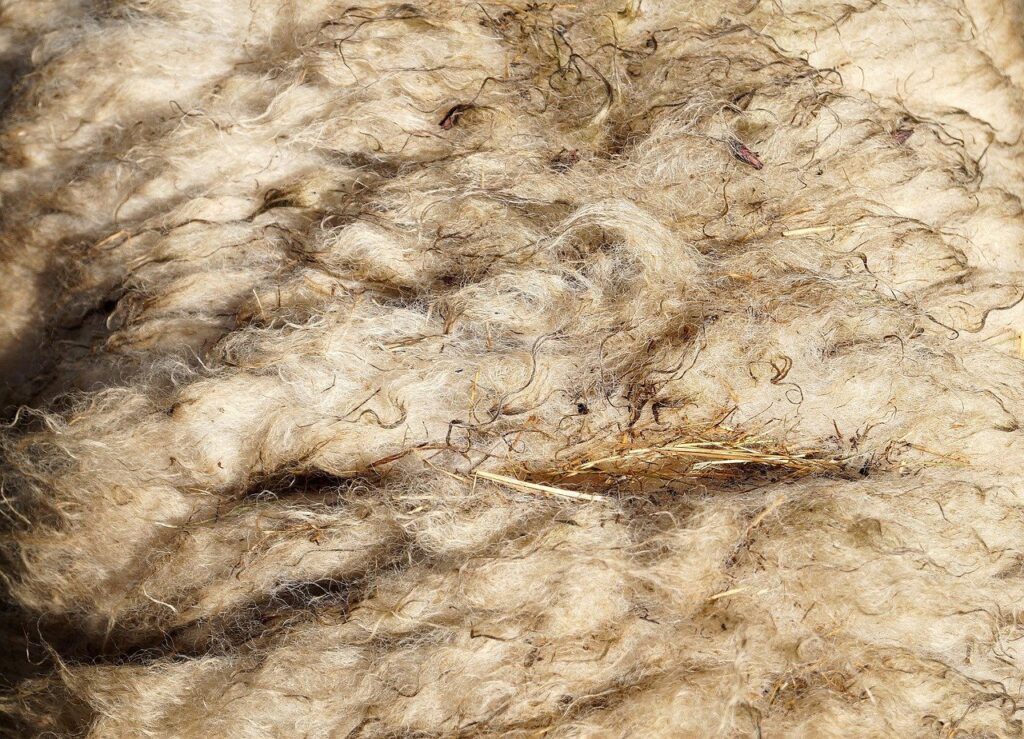
American labeling law blurs the line. The Wool Products Labeling Act is codified at 15 U.S.C. § 68. Its definition of “wool” covers sheep and lamb fleece, plus hair of the Angora or Cashmere goat.
That definition matters to a buyer. A U.S. label reading “wool” can legally cover mohair. The word alone does not prove a toy lamb wears sheep’s fleece.
Bear collectors face the same fiber question with early plush. Our teddy bear history covers Steiff’s first jointed plush bear, designed in 1902.
Historic Stuffed Toy Lambs in Museum Collections
Larry the Lamb, about 1950
Larry the Lamb began on the radio. The V&A explains that he starred in Toytown, a BBC Children’s Hour program created by Sydney George Hulme Beaman. The show was hugely popular in the late 1920s and early 1930s.
The museum’s toy version is jointed at the neck and all four limbs. Its catalog record reads like an identification checklist for mid-century lambs.
| Object | Larry the Lamb soft toy |
| Date | About 1950, probably England |
| Covering | Long white mohair |
| Stuffing | Wood wool mixture |
| Eyes | Dark glass, with white felt eyelids |
| Feet and ears | Black felt feet; ears lined with pale orange felt |
| Museum no. | B.80-2011, V&A |
Norah Wellings and Chad Valley lambs, 1930s
Two English cloth lambs at the V&A show the other main route. Norah Wellings made one between 1935 and 1939 from embroidered Yorkshire cloth.
Its ears are white wool cloth, and its tail is two cotton strands. Chad Valley’s lamb from the same decade is a cream cloth toy with stitched features and a pink ribbon at the neck.
The museum describes both as cloth toys. That flat surface is easy to tell from Larry’s long pile.
Lamb Chop, 1960 to 1963
The most famous American lamb was a puppet. The Henry Ford holds a Lamb Chop hand puppet made between 1960 and 1963, when The Shari Lewis Show aired on NBC.
Its record lists plastic and cloth, with no wool at all. Lewis later revived the character for Lamb Chop’s Play-Along!, which ran from 1992 to 1995.
How to Identify a Vintage Stuffed Sheep
Identification starts with the materials, then moves to labels. These checks draw only on the museum records above:
- Covering. Long pile may be mohair, as on Larry. Flat cloth matches the 1930s Wellings and Chad Valley lambs.
- Stuffing. Wood wool appears in the V&A’s 1950 Larry, so compare a lamb’s filling with dated examples.
- Eyes. Larry has dark glass eyes with felt eyelids, a detail worth matching on any lamb sold as mid-century.
- Joints. A lamb jointed at neck and limbs follows the same construction as early jointed bears.
- Labels. A maker’s label, like Chad Valley’s, is the strongest single clue to origin.
Fillings and coverings changed over the decades for every animal, as our account of how stuffed animals changed inside and out shows. Sheep followed the same path, only with more confusion about what counts as wool.
How Can You Date an Early 2000s Lamb Stuffed Animal?
Check for a permanent tracking label, which the U.S. Consumer Product Safety Commission requires on products primarily intended for children 12 and younger. The rule covers anything made on or after August 14, 2009.
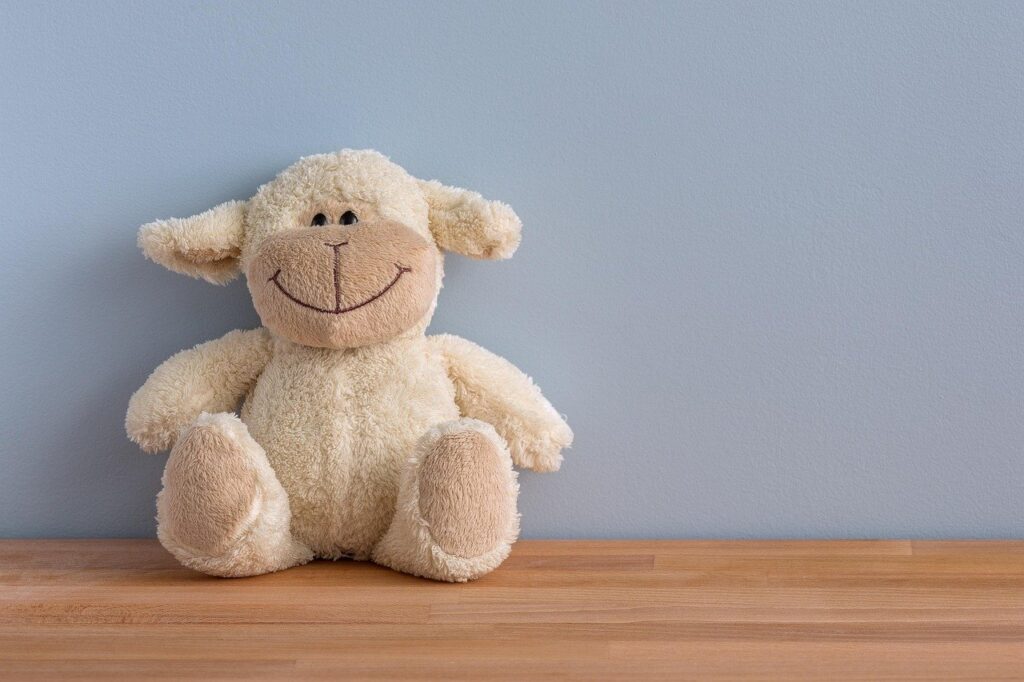
A lamb carrying that kind of label was made after the rule took effect. A lamb without one may be older, though it might also have been made for a market outside the United States.
That gap is useful for anyone hunting an early 2000s lamb stuffed animal from childhood. A missing tracking label fits the period, and the brand’s own tag can narrow it further.
Caring for Wool and Mohair Lambs
Animal fiber attracts one pest above all. Amgueddfa Cymru, the national museum of Wales, calls the webbing clothes moth the number one insect pest in museums worldwide.
Its larvae digest keratin, the protein in wool, fur, feathers, and hair. That list covers mohair as well as sheep’s wool, so a mohair lamb is no safer than a woolen one.
The museum adds that moth larvae prefer stained or dirty material. Keep a wool or mohair lamb clean, and check its seams and folded ears for the silky tubes the larvae spin.
Modern Stuffed Toy Lambs for Collectors
Mohair has not disappeared from the shelf. Steiff says it still uses natural fibers such as mohair for its collectibles, processed at its own Steiff-Schulte weaving mill in Germany. Our guide to popular plush brands covers the buttons and tags that separate genuine Steiff from lookalikes.
For mass-market lambs, the fiber label is the place to start. The question to ask any seller is the one Larry’s record answers on paper: what is the covering, and who says so?
Sources
- Victoria and Albert Museum, “Larry the Lamb,” B.80-2011, collections.vam.ac.uk.
- Victoria and Albert Museum, Soft toy, lamb, Norah Wellings, MISC.373-1981, collections.vam.ac.uk.
- Victoria and Albert Museum, Soft toy, lamb, Chad Valley, MISC.54-1964, collections.vam.ac.uk.
- University of Massachusetts Amherst, “Angora Goat Shearing,”, umass.edu.
- Legal Information Institute, Cornell Law School, 15 U.S. Code § 68, Definitions, law.cornell.edu.
- The Henry Ford, “‘Lamb Chop’ Hand Puppet, 1960-1963,”, thehenryford.org.
- U.S. Consumer Product Safety Commission, “CPSC to Enforce New CPSIA Requirements for Children’s Products Effective August 14,” 2009, cpsc.gov.
- Amgueddfa Cymru, “The Clothes Moth: Museums’ No.1 Insect Pest,”, museum.wales.
- Margarete Steiff GmbH, “Quality Promise,”, corporate.steiff.com.