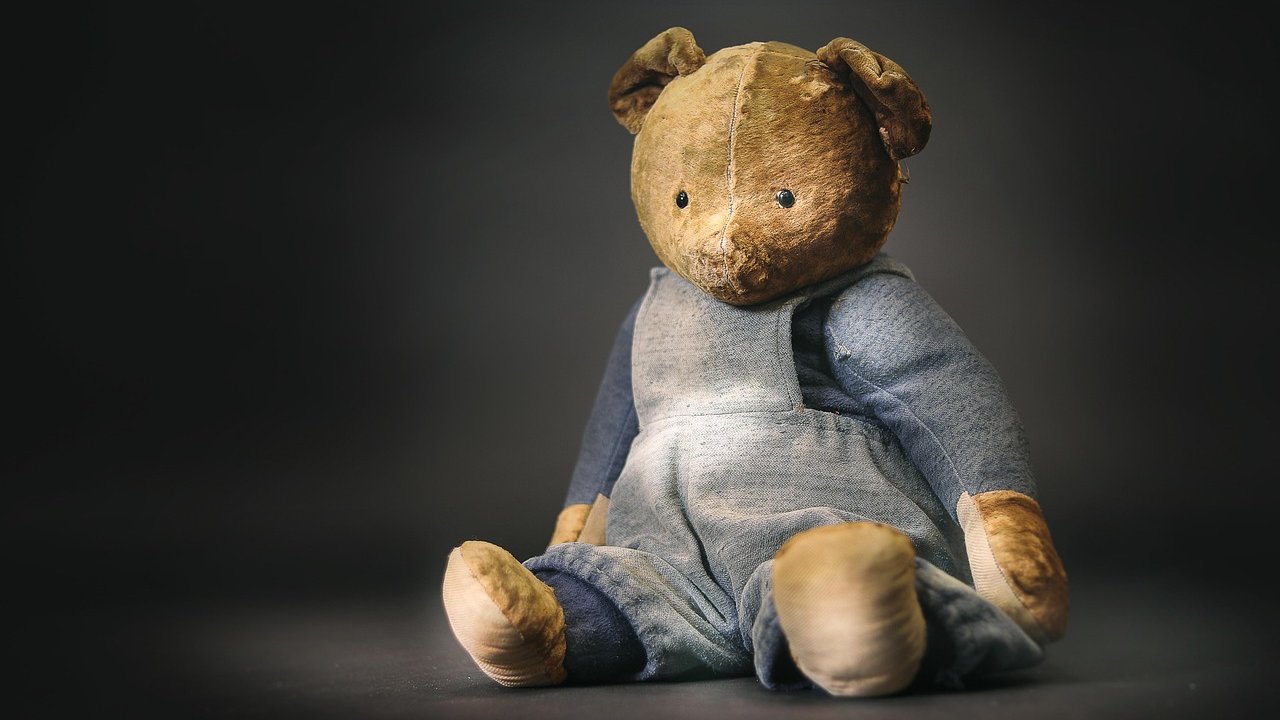
The teddy bear name origin is a joke that stuck to a president. After a newspaper cartoon in November 1902, toy sellers attached Theodore Roosevelt’s public nickname, “Teddy,” to a stuffed bear.
The odd part is the nickname itself. Roosevelt’s family never used it, and the man spent years keeping it at a distance.
This article covers the word only. It traces how “Teddy’s bear” became “teddy bear” and how Roosevelt felt about lending his name. The hunt itself and the first factories are covered in our full teddy bear history.
Where Did the Term Teddy Bear Come From?
The term teddy bear joins Roosevelt’s newspaper nickname to a bear he refused to shoot in Mississippi in 1902. Clifford K. Berryman drew that refusal for The Washington Post on November 16, 1902, and shopkeepers then sold stuffed bears as “Teddy’s bear.”
Here is the chain in the order the records support it. The National Park Service dates the hunt to November 14, 1902, near Onward, Mississippi. Two days later, the cartoon gave the public a picture of Roosevelt beside a bear.
The Park Service then credits Morris Michtom, a Brooklyn shopkeeper, with naming his toy. He called it “Teddy’s Bear.” The possessive made sense at first, because the bear belonged to Teddy in the cartoon’s story.
From “Teddy’s bear” to “teddy bear”
The apostrophe disappeared within a few years. Merriam-Webster dates the first known use of “teddy bear” to 1905. Its etymology names Roosevelt’s nickname and the cartoon as the source.
German usage followed the American craze. Steiff’s company timeline files the Roosevelt story under 1906. It links that year to the “Teddy boom” and to worldwide recognition for its bears.
So the word moved in three steps. A possessive label in 1902 and 1903 became a compound noun by 1905. By 1906 a German maker was using the American nickname for its own plush bears.
Berryman’s Cartoon Bear Did the Naming Work
A toy shop could not have named the bear alone. The name worked because readers already knew the bear from the newspaper, and they kept seeing it there.
A realistic bear that grew smaller
The Theodore Roosevelt Presidential Library points out that the bear in the first cartoon looked realistic and fierce. In later drawings Berryman made it smaller and cuter, and these became known as “Berryman bears.”
The real animal was neither small nor cute. The same library cites The Boston Globe of 1902 for a full-grown black bear of 225 pounds.
Roosevelt noticed the cartoons and liked them. The presidential library quotes a letter he wrote to Berryman on December 29, 1902:
“We have all been delighted with the little bear cartoons.”
Theodore Roosevelt to Clifford K. Berryman, December 29, 1902, as quoted by the Theodore Roosevelt Presidential Library
A recurring character in the Washington Post
The National Archives says Berryman’s cartoon of November 16, 1902, portrayed “the teddy bear for the first time.” Its biography of the cartoonist adds that the bear became a common symbol in his work. He kept drawing it long after 1902.
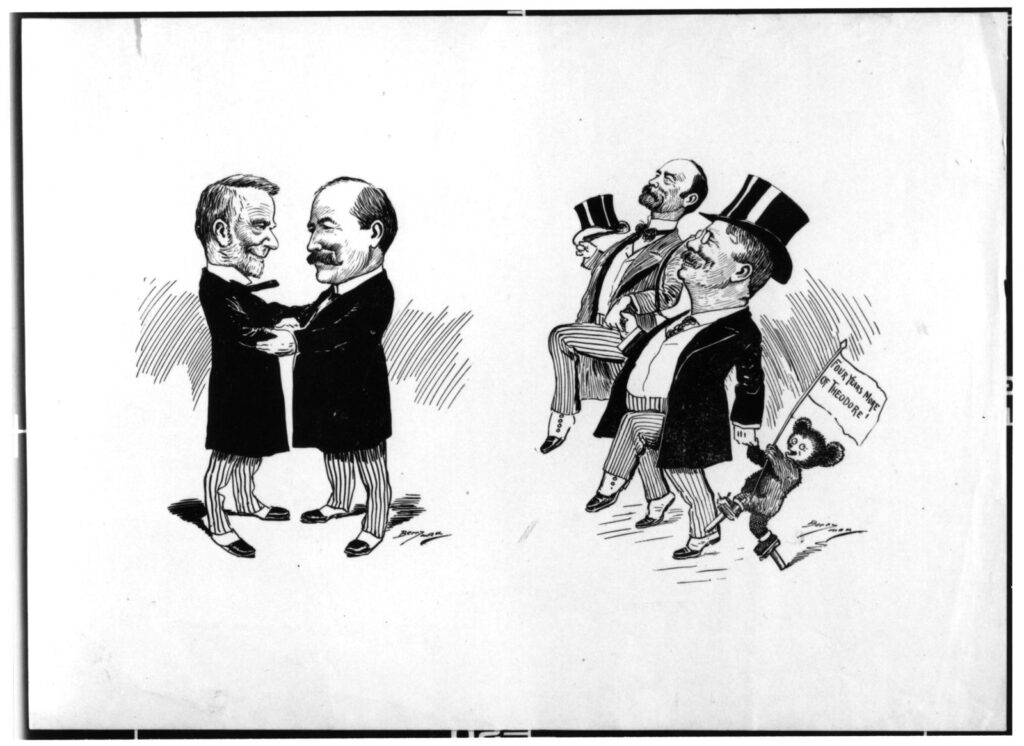
Berryman put the bear into election coverage. On November 9, 1904, the day after Roosevelt won a full term, the Post ran a victory parade. The bear marched beside him with a flag reading “Four More Years of Theodore.”
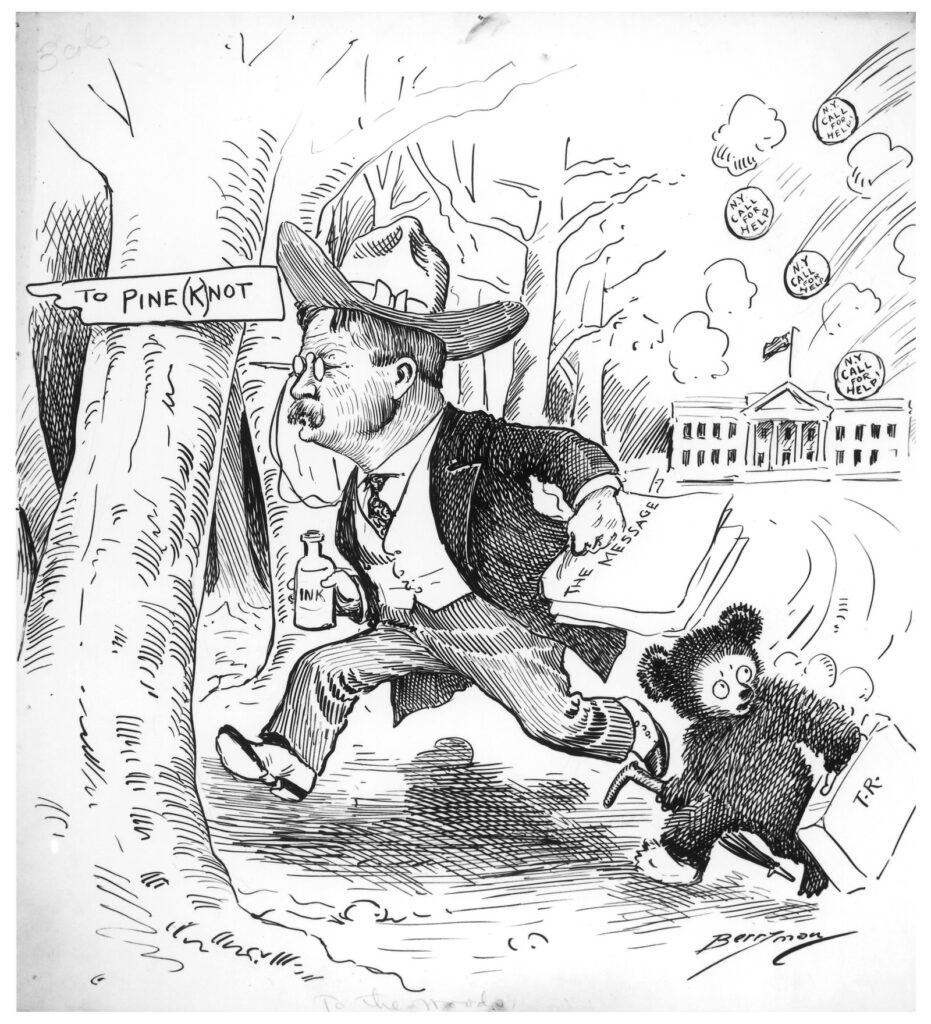
By 1906 the bear needed no introduction. In “To the Woods!” it trots after Roosevelt carrying a case marked “T.R.,” and no label explains who it is.
Named After Theodore Roosevelt, the 26th President
Teddy bears are named after Theodore Roosevelt, who served as the 26th president from 1901 to 1909. People sometimes guess Franklin D. Roosevelt, his fifth cousin, but FDR took office in 1933, three decades after the toy was named.
The family story of the name has one gap. According to the Theodore Roosevelt Presidential Library, Michtom family tradition says Morris asked permission to use the name. The same library says no such letter has ever been found.
Two National Park Service pages handle that gap differently. The Birthplace page states the permission as fact. The Inaugural Site page calls it something the Michtom family “claimed.”
Roosevelt and the Nickname He Kept at Arm’s Length
Roosevelt did not grow up as Teddy. His childhood name was Teedie, and the presidential library cites a 1905 account by Orison Swett Marden. Marden wrote that the family switched to Theodore around 1873.
He did sign letters as Teddy now and then. The library counts about 12 such signatures in nearly 300 letters from 1867 to 1885. The last one is dated July 1, 1883.
“Father didn’t like to be called Teddy.”
Alice Roosevelt Longworth, as quoted by the Theodore Roosevelt Presidential Library
Press reports about the nickname pull in different directions. Here is how the record reads, in date order:
- Against the nickname. The Tammany Times reported in May 1903 that a boy who shouted “Hello Teddy!” at Roosevelt in Yosemite received “a prompt Presidential veto.”
- Doubt about that story. A 1907 Chicago Tribune piece said Roosevelt’s friends doubted he had said anything of the kind.
- A softer line in 1910. The Boston Globe of August 26, 1910, quoted him telling a congressman that he once thought “Teddy” lowered his dignity, “but now, don’t you know, I rather like it.”
Our reading is simple. Roosevelt disliked the nickname as a form of address and tolerated it as a crowd chant. He never fought the toy that made it permanent.
The Name That Outlasted Its Rival
The clearest test of the name came in 1909. William Howard Taft was about to succeed Roosevelt. On January 15, 1909, the Atlanta Chamber of Commerce honored him with a possum dinner.
The Theodore Roosevelt Center describes what followed: a plush “Billy Possum,” marketed as the teddy bear’s successor. Plush toys, postcards, and sheet music appeared, and the craze faded by Christmas 1909.
The name tells you whom the bear honors, not who made it. A seller who describes a bear as “named for Roosevelt” has said nothing about its age or maker. Ask for the maker’s mark, the stuffing, and a dated paper trail instead.
Where the Teddy Bear Name Origin Story Still Disagrees
Three details shift depending on the source. None of them should be stated with full confidence:
- The permission letter. One National Park Service page treats Roosevelt’s permission as fact, another calls it a family claim, and the presidential library says no letter has been found.
- The first date of “teddy bear.” Merriam-Webster gives 1905 for the compound noun, while Steiff’s timeline places the Roosevelt connection under 1906.
- The bear in the cartoon. Merriam-Webster’s etymology calls it a bear cub. The presidential library says the first drawing showed a realistic, fierce bear that only later became small and cute.
The word survived a president who preferred Theodore and a rival toy built to replace it. That leaves collectors with a fair question. If the name was never Roosevelt’s choice, how much of his story should a bear’s label claim?
Sources
- National Park Service, Theodore Roosevelt Birthplace, “The Story of the Teddy Bear,”, nps.gov.
- National Park Service, Theodore Roosevelt Inaugural Site, “Teddy Bear History,”, nps.gov.
- National Archives, “Clifford K. Berryman Biography,”, archives.gov.
- Theodore Roosevelt Presidential Library, “What TR Thought About ‘Teddy’,”, trlibrary.com.
- Theodore Roosevelt Presidential Library, “Did Roosevelt Like Being Called ‘Teddy’?”, trlibrary.com.
- Theodore Roosevelt Presidential Library, “Top 10 Myths about Theodore Roosevelt and the Invention of the Teddy Bear,”, trlibrary.com.
- Theodore Roosevelt Center, “Billy Possum,” The Bully Pulpit, 2026, trcenter.substack.com.
- Merriam-Webster, “teddy bear,”, merriam-webster.com.
- Margarete Steiff GmbH, “From the past to the present,”, corporate.steiff.com.
3 thoughts on “The Teddy Bear Name Origin and the Nickname TR Disliked”