
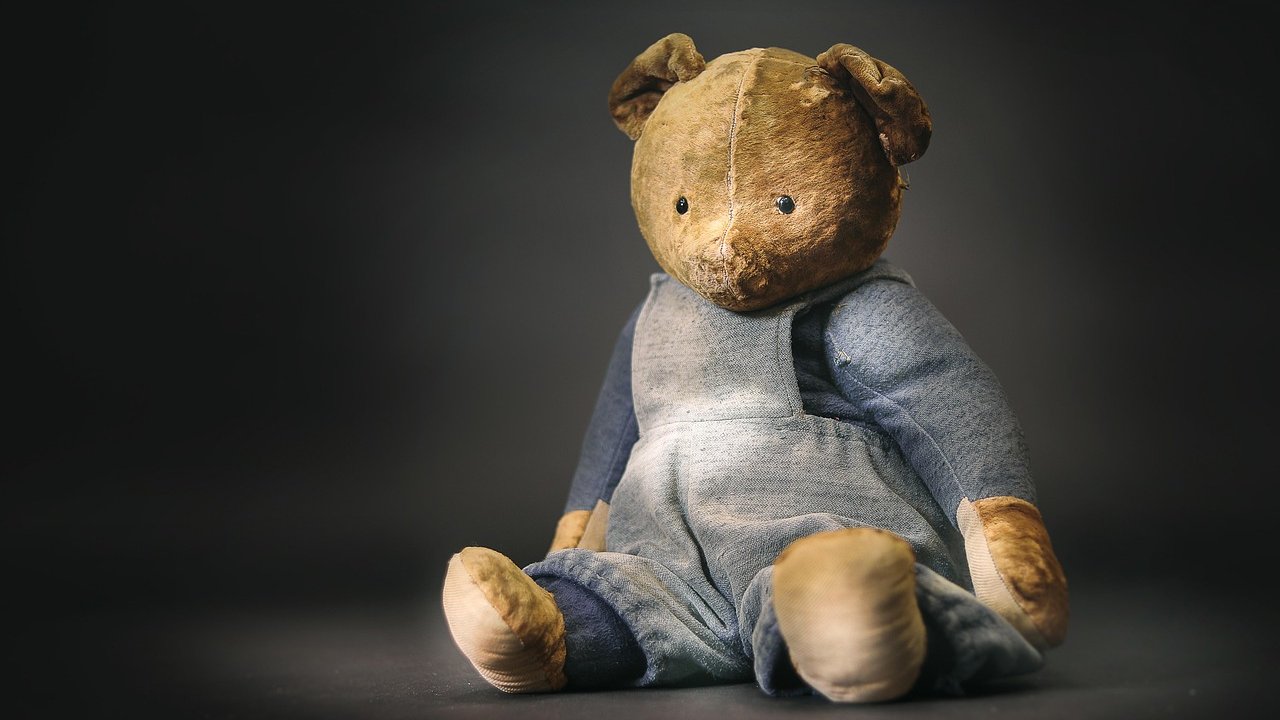
Teddy bears became popular because almost every mass medium of the early 1900s picked them up at once. Between 1904 and 1910, the bear showed up in a presidential campaign, the Sunday comics, Broadway, an Edison film, and a hit piece of sheet music.
The hunt and the first two bears are a separate story, told in our teddy bear history guide. This piece starts where that one ends: with a new toy that still had to win buyers.
How Did Teddy Bears Become Popular in Under a Decade?
The short answer is repetition across channels. A child in 1907 could read about bears in the paper, see them on stage or screen, hum a bear tune, and win a bear on the boardwalk. The same image reached adults through politics and magazines.
No single channel would have been enough on its own. Three facts about teddy bears explain the speed of the craze:
- The president used it. Roosevelt adopted teddy bears as a symbol of his 1904 campaign, according to the Smithsonian’s National Museum of American History.
- Factories could keep up. Steiff alone made 973,999 teddy bears in 1907, by the company’s own count.
- A rival failed in public. When a “Billy Possum” toy tried to replace the bear in 1909, newspapers reported the flop.
A President Who Let the Bear Campaign
Roosevelt’s campaign used the toy named after him instead of fighting it. The Smithsonian holds a 1904 campaign button and notes that Roosevelt adopted teddy bears as a campaign symbol after the hunting story spread.
In effect, each bear button advertised the toy for free. The 1904 election carried that image to voters across the country, two years before the Sunday-paper bears arrived.
Newspapers, Stage, and Screen Sold the Bear
The Roosevelt Bears in the Sunday papers
Seymour Eaton, writing as “Paul Piper,” launched a rhyming serial called The Roosevelt Bears with illustrations by V. Floyd Campbell. The Minneapolis Journal ran the opening installment on January 7, 1906, and the Theodore Roosevelt Center lists the same date for its copy.
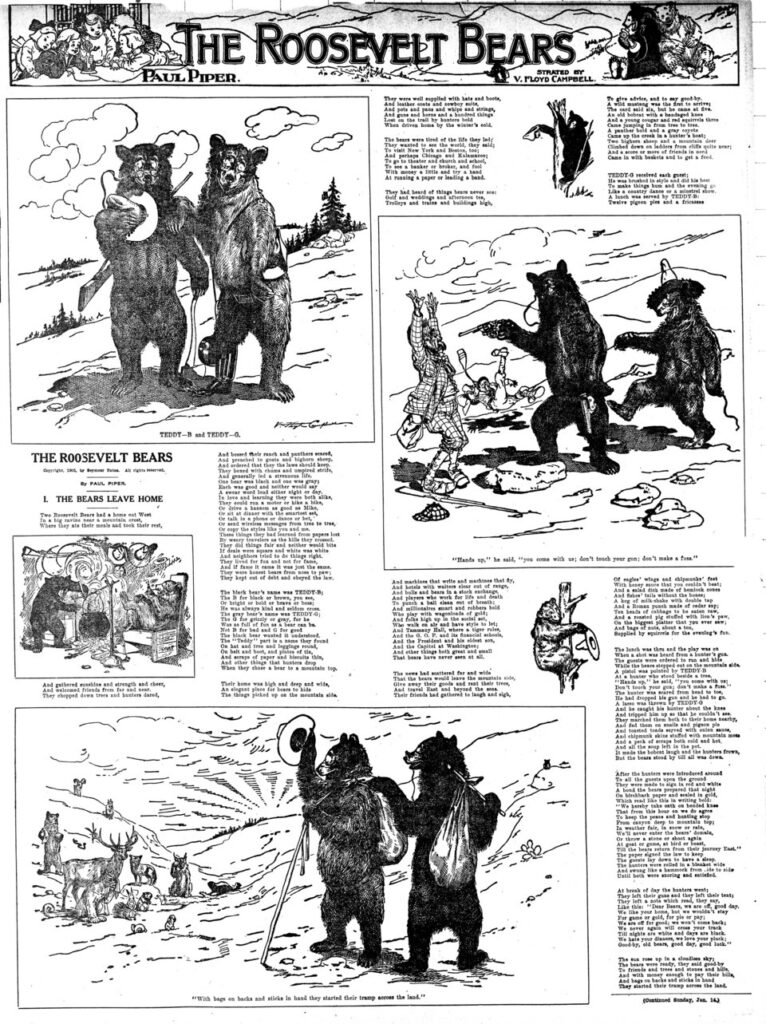
The dates shift slightly depending on where you look. The newspaper page itself carries a “Copyright, 1905, by Seymour Eaton” line. The bound book appeared in 1906 from E. Stern and Company in Philadelphia.
The bears, Teddy-B and Teddy-G, traveled the country in weekly episodes. For a child reading the funnies, that meant a new bear adventure every Sunday.
Anna Held and the Broadway bears
Broadway gave the bear glamour. Smithsonian Magazine describes Anna Held as Broadway’s most popular musical comedy star and reports that she appeared onstage with life-size teddy bears. A photograph held by the Folger Shakespeare Library shows the act, dated only to “1906 or 1907.”
A 1907 film made one frame at a time
In 1907, Edison’s studio released The “Teddy” Bears, a 13-minute film by Wallace McCutcheon and Edwin S. Porter. The National Film Preservation Foundation says it mixes the Goldilocks tale with political satire, and a Roosevelt figure turns up as a hunter at the end.
The film’s stop-motion sequence of toy bears was shot frame by frame. According to the foundation, it took Porter a week of eight-hour days. The Library of Congress holds the 35mm print the foundation used for its release.
Boardwalks, Magazines, and the Business of Bears
The Strong National Museum of Play describes how far the bear spread beyond the toy shop. Visitors to New Jersey’s seaside resorts took bears home as boardwalk prizes. Women’s magazines ran ads for bear accessories and printed patterns for sewing bear clothes.
That second detail matters for anyone dating old bears. A teddy bear with home-sewn clothes was a normal product of the era, made by a parent working from a magazine pattern.
Boardwalk prizes and home-dressed bears often carry no maker’s mark. An unmarked early-style bear can still be old, but it needs other evidence: construction, stuffing, wear, or a dated family photograph.
The Strong’s account also differs from the manufacturer’s on one date. The museum says Steiff began mass-producing its bear in 1903, while Steiff’s own timeline puts the first big order at the 1902 Leipzig fair.
The Billy Possum Test of 1909
The real proof of the bear’s popularity came when someone tried to replace it. On January 15, 1909, the Atlanta Chamber of Commerce held a “possum and taters” banquet for President-elect William Howard Taft. A cartoon in the Atlanta Constitution had already declared “Billy Possum” the new national toy.
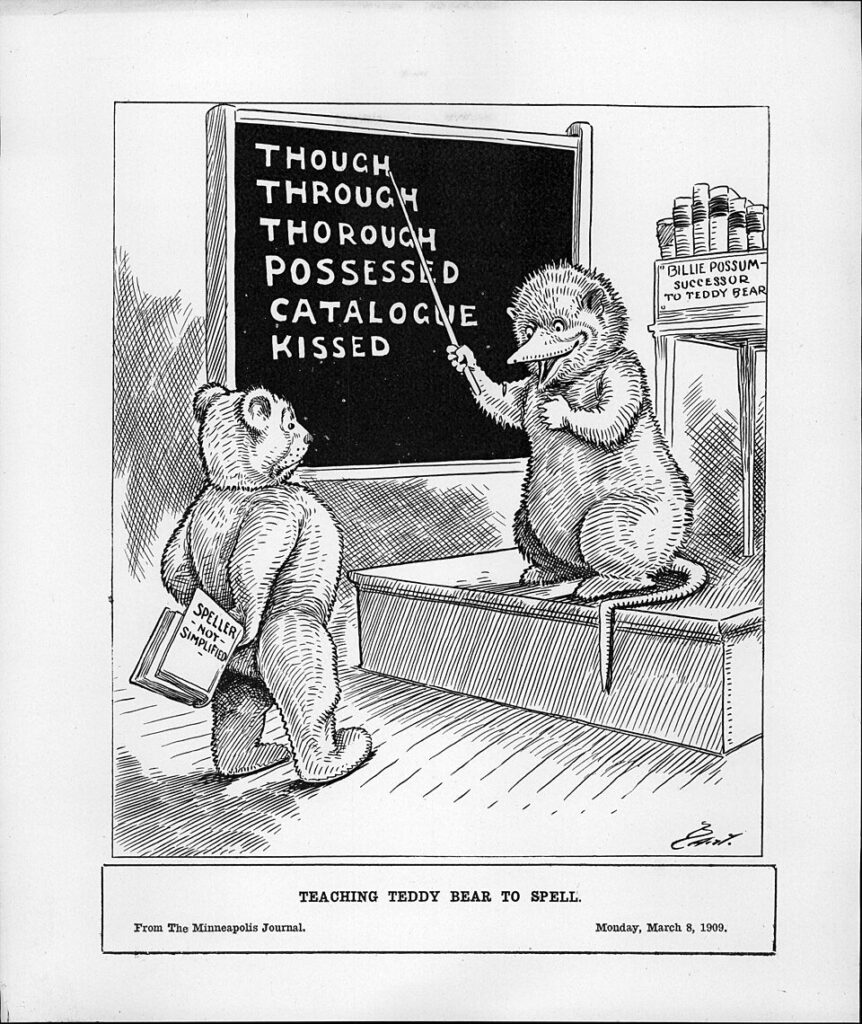
Susie Wright Allgood, a wealthy Georgia widow, formed the Georgia Billy Possum Company and pushed the toy hard. Smithsonian Magazine reports that children found it “too much like a rat.” By July 1909, the Spokane Press ran the headline “Billy Possum a Failure but Teddy Bear Still a Joy With Little Ones.”
Even Steiff tried. Its Billy Possum sold 10,028 units in its first year and only a few hundred over the next several years, according to Smithsonian Magazine. Richard Steiff later blamed politics and looks.
“I don’t believe in mixing toys and politics. But they kept at me to make the ‘Billy Possum’ and then nobody wanted it.”
Richard Steiff, quoted in the American Stationer in 1912, via Smithsonian Magazine
The possum had the same political tie-in as the bear and lost anyway. That suggests children, more than campaign managers, had decided what the bear meant. The naming side of that contest is covered in our piece on why the teddy bear name outlasted its rival.
A Song That Kept Playing After the Fad
John W. Bratton composed the tune in 1907, and the Library of Congress credits Jimmy Kennedy with adding lyrics in 1932. That 25-year gap helps explain the song’s long life, because the tune was already familiar when the words arrived.
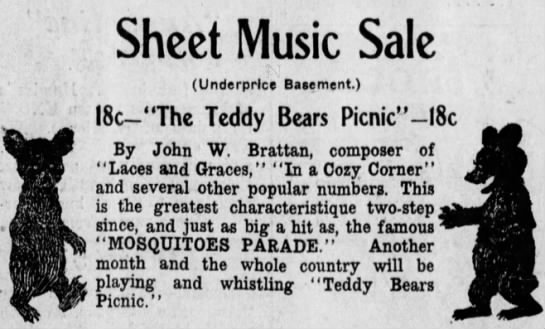
The early title is a small puzzle. The Library of Congress timeline gives Bratton’s instrumental a two-step title. Yet a Minneapolis newspaper ad from April 1908 already sold the sheet music as “The Teddy Bears Picnic” for 18 cents.
A Short History of a Teddy Bear Craze
The timeline below covers the popularity years only. The dates come from the sources listed at the end, and the uncertain ones are marked.
- 1904 Roosevelt’s campaign adopts the teddy bear as a symbol, per the Smithsonian.
- 1906 The Roosevelt Bears begins in Sunday papers on January 7; the page carries a 1905 copyright.
- 1906 Anna Held performs with life-size bears on Broadway, in 1906 or 1907.
- 1907 Edison releases The “Teddy” Bears, and Bratton composes his bear two-step.
- 1907 Steiff makes 973,999 teddy bears.
- 1908 Minneapolis shoppers can buy “The Teddy Bears Picnic” sheet music for 18 cents.
- 1909 Billy Possum launches in January and is called a failure by July.
- 1932 Jimmy Kennedy adds lyrics to “Teddy Bears’ Picnic.”
- 1998 The teddy bear enters the National Toy Hall of Fame in its first year.
From Fad to Fixture
The Strong inducted the teddy bear into the National Toy Hall of Fame in 1998, the hall’s first year. The museum calls it the most popular plush toy in history, a claim that is hard to measure but easy to believe. Our list of fun facts about teddy bears shows how far that popularity has traveled since.
Here is a fun fact about teddy bears that the Billy Possum story makes plain. Marketing made the bear famous between 1904 and 1910, yet children kept it after the marketing stopped. Any plush that trends today faces the same test: will anyone still want it once the advertising ends?
Sources
- Smithsonian National Museum of American History, “Campaign Button, Theodore Roosevelt, 1904,” americanhistory.si.edu.
- Margarete Steiff GmbH, “From the past to the present,” corporate.steiff.com.
- Theodore Roosevelt Center, Dickinson State University, “The Roosevelt bears,” 1906, theodorerooseveltcenter.org.
- Library of Congress, Chronicling America, The Minneapolis Journal, January 7, 1906, chroniclingamerica.loc.gov.
- Internet Archive, Seymour Eaton, “The Roosevelt Bears: Their Travels and Adventures,” 1906, archive.org.
- Smithsonian Magazine, “How a Stuffed Animal Named Billy Possum Tried and Failed to Replace the Teddy Bear as America’s National Toy,” 2025, smithsonianmag.com.
- National Film Preservation Foundation, “The ‘Teddy’ Bears (1907),” filmpreservation.org.
- The Strong National Museum of Play, “Teddy Bear,” National Toy Hall of Fame, museumofplay.org.
- Library of Congress, Songs of America, “1900 to 1949,” loc.gov.
2 thoughts on “How Did Teddy Bears Become Popular So Quickly?”