
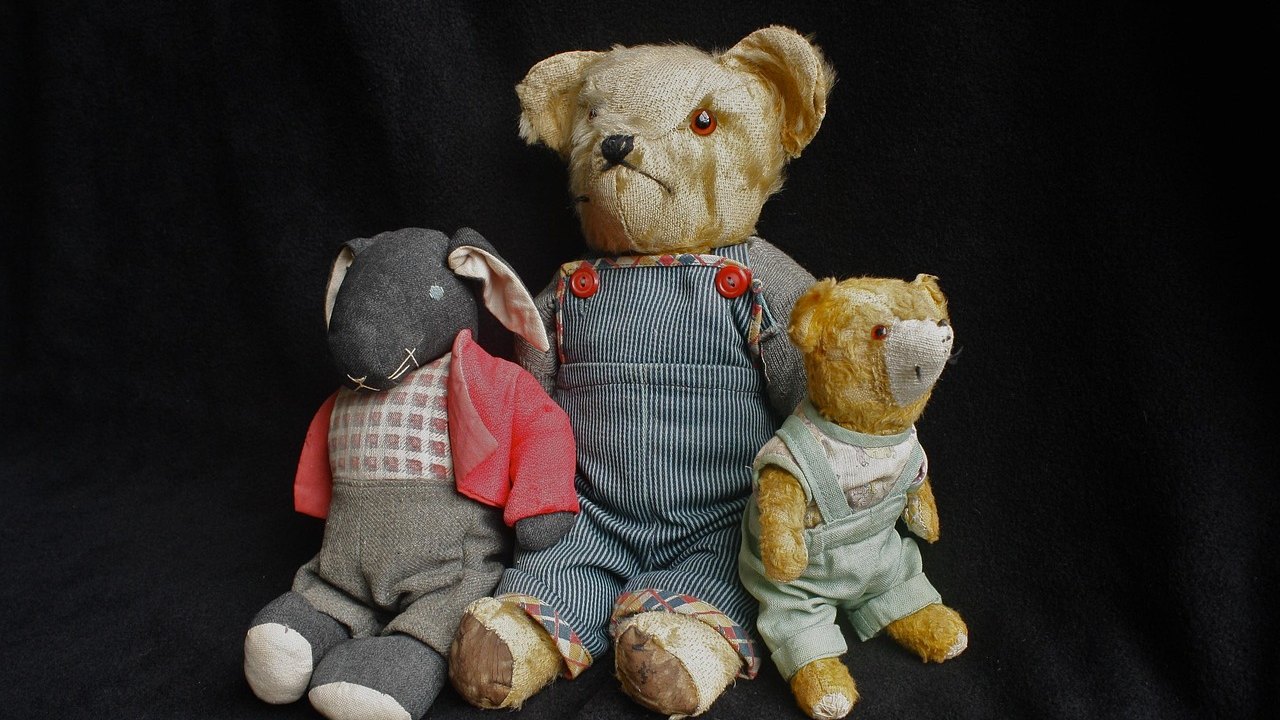
The history of stuffed animals starts with cloth, not with bears. Children in Roman Egypt played with linen dolls packed with rags and papyrus. Museums still hold a few of them.
The commercial story begins in 1880, when a German seamstress sewed a small felt elephant. This guide covers the stretch between those points and the century after. The teddy bear gets one chapter, since our full teddy bear history covers it in depth.
The History of Stuffed Animals Begins With Dolls
Linen and papyrus in Roman Egypt
The oldest stuffed playthings in museum catalogs are dolls. The British Museum describes a Roman-period rag doll made in Egypt between the 1st and 5th centuries AD. Its body is coarse linen, stuffed with rags and pieces of papyrus.
The Victoria and Albert Museum holds a similar papyrus-stuffed doll from Oxyrhynchus, dated to about AD 200 to 400. We look at that doll, and at what counts as a soft toy, in when the first soft toy was made.
A long gap in the record
Stuffed animals are harder to trace. We searched British Museum and V&A records for a sewn, stuffed animal toy from antiquity. We found none, and our search for the oldest plush in the world starts in 1892 as a result.
That gap probably says more about survival than about play. Cloth rots, and children wear soft toys out. A history of plushies built only from surviving objects will always lean toward the toys that someone decided to keep.
Felt Animals and Printed Cloth, 1880 to 1900
Margarete Steiff’s felt elephant
Margarete Steiff was born in 1847 in Giengen an der Brenz, in southern Germany. She contracted polio at 18 months and later ran a felt clothing shop, which she opened in 1877. In 1880 she sewed a small felt elephant from a pattern in a fashion journal.
Steiff treats 1880 as its founding date. On March 3, 1893, the business was registered as a felt toy factory, and Harrods in London became its first foreign customer in 1895.
That sequence makes Steiff the clearest early case of a stuffed animal sold as a product, which is why we credit her in who invented the first stuffed animal. Earlier homemade animals surely existed, but they left no company records behind.
Sew-it-yourself cats from Ithaca
The United States took a different route. In 1892, Celia Mattison Smith and Charity Smith of Ithaca, New York, designed a three-panel cloth cat modeled on Celia’s pet. According to the National Archives, their “Tabby Cat” was patented on July 5 and October 4, 1892.
Arnold Print Works in Massachusetts bought the pattern and printed it on cotton. Buyers cut out the pieces, sewed them, and stuffed them at home. The National Archives says the cat sold across the United States and reached Europe and South America.
When Did Stuffed Animals Become Everyday Toys?
Stuffed animals became everyday nursery toys between the 1890s and the 1910s. From 1892, printed cotton panels from Arnold Print Works let American families sew them at home. In Germany, Steiff was selling felt animals to Harrods by 1895, and its mohair bear of 1902 set off a plush boom.
Before that window, a stuffed toy usually meant something a parent sewed from scraps. Afterward, a child could own a factory-made animal with a brand name and a catalog number.
Plush Arrives, 1902 to the 1920s
The word plush entered the story with a specific fabric. In 1902, Richard Steiff designed the Bear 55 PB in mohair plush from a Duisburg weaving mill. Our account of how the teddy bear began covers the boom that followed.
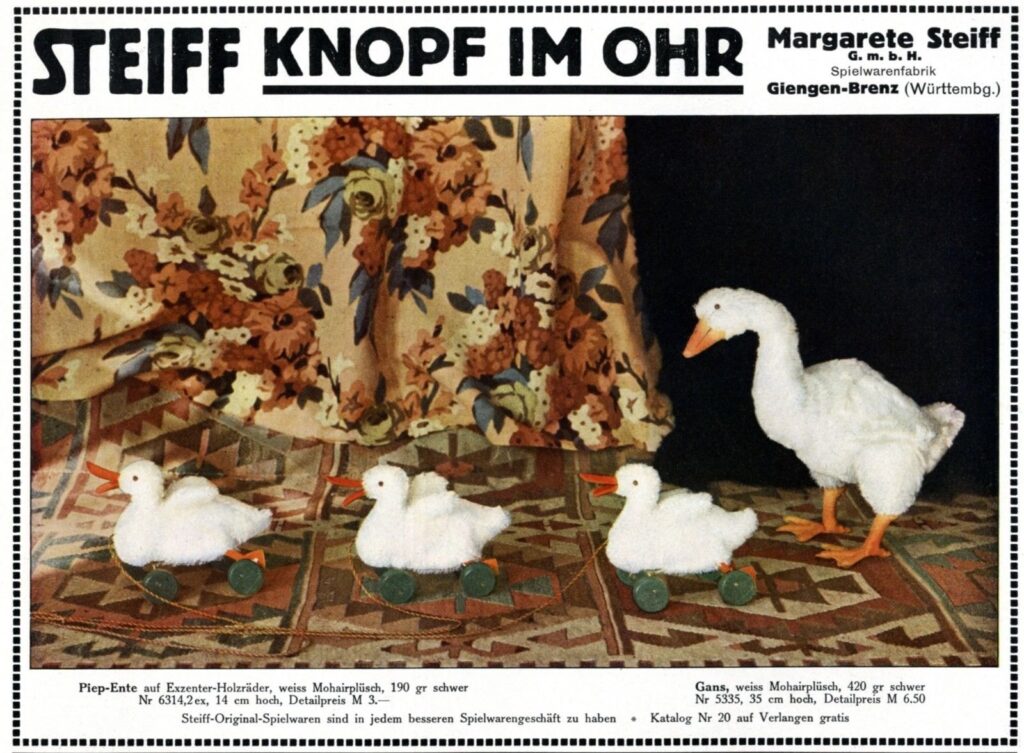
Steiff did not stop at bears. Its 1914 advertising, sold under the “button in the ear” trademark, shows toy ducks and a goose on wheels. Farmyard and zoo animals kept the firm tied to its felt-elephant beginnings.
Characters from books
Children’s books turned stuffed animals into characters. In December 1903, Beatrix Potter began sewing a Peter Rabbit doll for the niece of her publisher, Norman Warne. The V&A’s catalog says she patented it on December 28, 1903.
“The expression is going to be lovely; especially the whiskers – (pulled out of a brush!)”
Beatrix Potter on her Peter Rabbit doll, December 1903, as quoted in the V&A catalog
The traffic soon ran the other way, from toy to book. The New York Public Library says Christopher Robin Milne received a Harrods teddy bear on his first birthday in 1921. That bear and its companions became the cast of his father’s Winnie-the-Pooh stories.
The original toys now sit in the library’s collection in New York. They are worn, patched, and plainly loved. That makes them better evidence of real play than any mint catalog example.
Adults carried stuffed animals too. During the 1924 World Flight, each crew member carried a stuffed monkey as a mascot, according to the Smithsonian’s National Air and Space Museum.
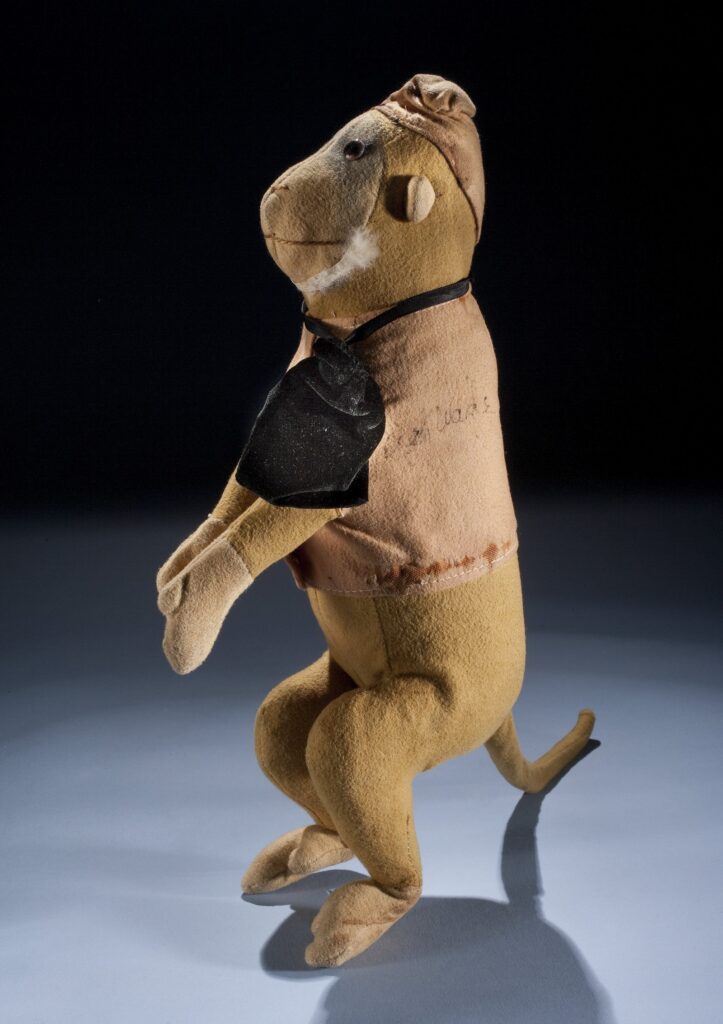
The one called “Maggie” flew aboard the Douglas World Cruiser “Boston” as a good-luck charm. Its cotton vest still carries the signature of the plane’s pilot, Lt. Leigh Wade.
Stuffed Animals History After 1945
The postwar decades changed what stuffed animals were made of. For a 1960s bear by the Welsh firm Wendy Boston, the V&A records nylon plush, locked-in plastic eyes, and foam filling. Its advertising card claimed the firm made the world’s first complete range of washable soft toys.
Steiff tells a parallel story about its own products. The company restarted production in 1947 and dates its first fully washable jointed teddy bear, Teddy Petsy, to 1984. The fabrics and fillings behind those changes are traced in our guide to how stuffed animals evolved.
The Wendy Boston claim and the Steiff claim do not cancel each other out. The V&A’s Wendy Boston bear has an all-in-one body with no joints, whereas Steiff’s 1984 statement covers jointed bears. Treat any “first washable” label with the same caution as a “first teddy” label.
Collecting also became part of the history itself. In 1980, Steiff opened its museum in Giengen and began issuing limited-edition replicas of older designs. From then on, the market made new toys that were meant to look old.
A Timeline of Stuffed Animals, AD 200 to 1984
The dates below come from the sources listed at the end of this article. Where a source frames a date loosely, the entry says so.
- AD 1st–5th c. A linen rag doll stuffed with rags and papyrus is made in Roman Egypt, per the British Museum.
- c. AD 200–400 The V&A’s Oxyrhynchus doll, stuffed with papyrus, is made.
- 1880 Margarete Steiff sews her felt elephant.
- 1892 Celia and Charity Smith patent the “Tabby Cat” on July 5 and October 4.
- 1893 Steiff registers its felt toy factory on March 3.
- 1895 Steiff begins selling to Harrods in London.
- 1902 Richard Steiff designs the mohair Bear 55 PB.
- 1903 Beatrix Potter makes and patents a Peter Rabbit doll in December.
- 1921 Christopher Robin Milne receives the Harrods bear that became Winnie-the-Pooh.
- 1947 Steiff restarts production after the Second World War.
- 1980 The Steiff Museum opens, and limited-edition replicas begin.
- 1984 Steiff introduces Teddy Petsy, its first fully washable jointed bear.
Where the Sources Disagree
Three details in this history shift depending on who tells it. None of them changes the broad outline, but each one matters to a careful reader.
- The first patent. Many retellings call a 1903 toy the first patented stuffed animal. The National Archives record of the Smiths’ 1892 patents predates the Peter Rabbit doll by more than a decade.
- Patent or registration. The V&A says Potter “patented” her doll. We could not see the original 1903 filing, so whether it was a patent or a design registration remains an open question.
- Paper plush. Steiff’s teddy history dates its paper plush bear to 1919, while its company timeline groups paper materials with the war and postwar years in an entry headed 1925.
What survives in museums is a narrow slice of what children owned. The real open question is how many homemade animals from before 1880 were simply loved to pieces and thrown away.
Sources
- The British Museum, “Rag doll,” Roman, 1st–5th century AD, bmimages.com
- Victoria and Albert Museum, “Doll,” Oxyrhynchus, about AD 200–400, 1937-1897, collections.vam.ac.uk
- Margarete Steiff GmbH, “From the past to the present,” corporate.steiff.com
- Margarete Steiff GmbH, “A legendary invention,” corporate.steiff.com
- National Archives, NHPRC News, August 2021, “The Ithaca Kitty,” archives.gov
- Victoria and Albert Museum, Beatrix Potter, “Samuel Whiskers and Anna Maria rolling Tom Kitten in pastry,” catalog essay, collections.vam.ac.uk
- The New York Public Library, “Winnie-the-Pooh at 100,” nypl.org
- Smithsonian National Air and Space Museum, “Mascot, Douglas World Cruiser, ‘Maggie’,” 1924, A19880404000, si.edu
- Victoria and Albert Museum, “Judy,” teddy bear, Wendy Boston, 1960s, MISC.124-1988, collections.vam.ac.uk
4 thoughts on “The History of Stuffed Animals Is Older Than the Teddy Bear”