
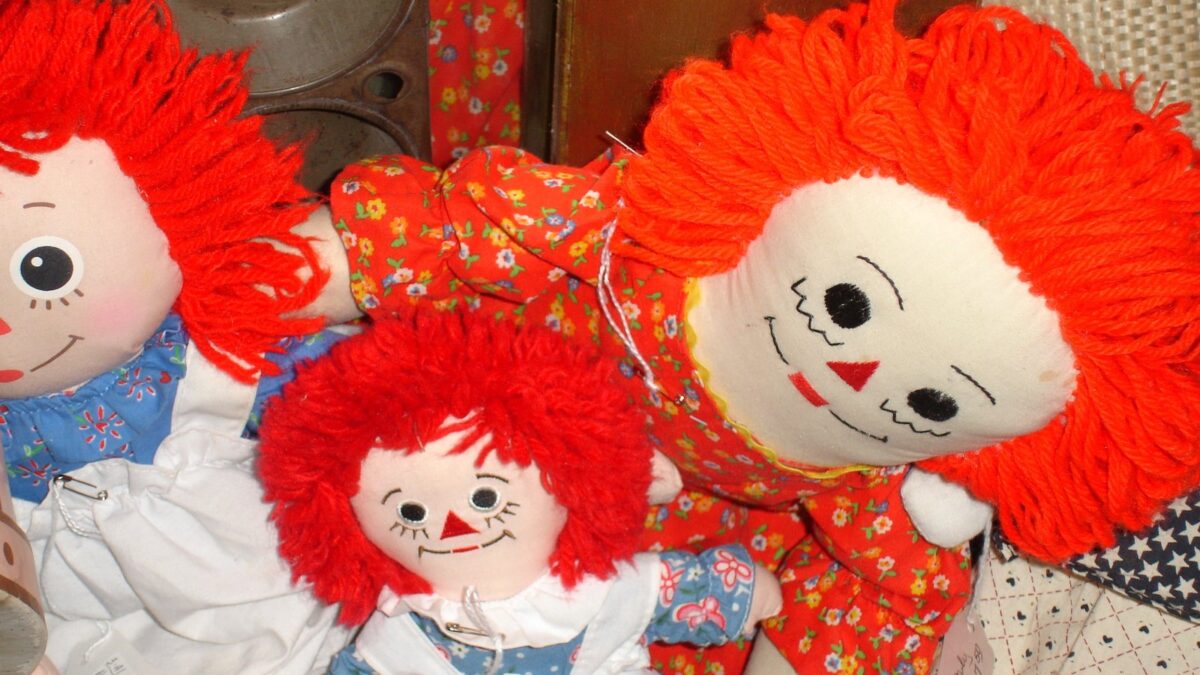
An antique Raggedy Ann doll is easiest to date by its maker. The same red-yarn rag doll has been sewn by a string of licensed companies since 1918, and each left different clues.
The Strong National Museum of Play names the line in order: P. F. Volland first, then Molly’es, Georgene, Knickerbocker, Applause, Hasbro, and others. This guide walks through those eras, where the records agree, and where collector guides disagree on dates.
Johnny Gruelle, Raggedy Ann, and the First Dolls
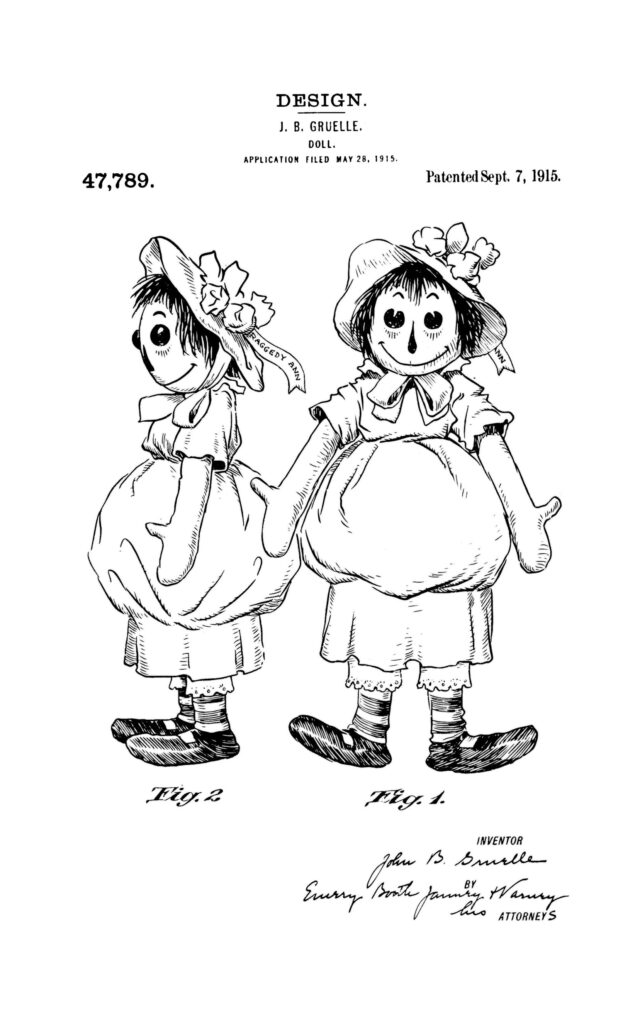
Johnny Gruelle patented the doll’s design in 1915, a story told in full in our history of dolls. The commercial doll arrived three years later, tied to a book, much as the Kewpie doll grew out of magazine drawings and a 1913 design patent.
The Strong says Gruelle, a cartoonist and illustrator, wrote a children’s book about Raggedy Ann in 1918. Publisher P. F. Volland sold the dolls alongside it, and the pairing became a marketing hit.
Even the origin story has two versions. The Strong repeats the tale of his daughter Marcella bringing him an old rag doll in 1915, while other accounts place the find in his parents’ attic.
Antique Raggedy Andy Dolls Join in 1920
Raggedy Andy is younger than his sister. The Strong dates Gruelle’s Raggedy Andy Stories to 1920, so a matched Ann and Andy pair cannot predate that year as a set.
In the stories, the two dolls came to life whenever humans weren’t looking. Gruelle averaged one new book a year for twenty years, which kept both dolls in shops long after the first printing.
Maker Eras of the Antique Raggedy Ann Doll
- 1918 Volland sells Raggedy Ann dolls with Gruelle’s first book, per The Strong.
- 1920 Raggedy Andy Stories appear, and Andy joins the doll line.
- 1934 The Strong says the Great Depression forced Volland to close.
- 1930s Molly’es makes dolls; collector accounts disagree on the dates and on whether Gruelle authorized them.
- 1930s–1960s Georgene Novelties produces the dolls for about 25 years, per The Strong.
- 1973 A boxed Knickerbocker Raggedy Ann made in Taiwan enters the V&A collection the next year.
- 2002 Raggedy Ann enters the National Toy Hall of Fame; Andy follows in 2007.
Volland, 1918 to 1934
Volland dolls are the earliest commercial examples. The Strong holds a Volland Raggedy Ann dated 1920 to 1925, which gives collectors a museum-dated reference for the period.
Molly’es and the gap years
The Strong lists Molly’es, the firm run by Mollye Goldman, as the next maker after Volland. Accounts of the mid-1930s differ sharply. Some collector histories describe a lawsuit by Gruelle over unauthorized dolls, and they disagree on the year and the result.
That uncertainty matters for buyers, because a firm maker attribution is much of what makes vintage stuffed animals worth money. A doll sold as “1935 Molly’es” deserves the same scrutiny as any attribution resting on a single dealer’s word.
Georgene Novelties
The Strong says Gruelle arranged for Georgene Novelties to manufacture the dolls after Volland closed, for the next 25 years. Collector guides usually start the Georgene run in 1938, which leaves a gap the museum record does not explain.
Knickerbocker, Applause, and Hasbro
The Victoria and Albert Museum holds a Knickerbocker Raggedy Ann made in Taiwan in 1973. Its record lists sewn cotton, red wool hair, a blue and white floral skirt, a white apron, and a printed card box.
Collector guides commonly date the Knickerbocker era to 1963 through 1982. The V&A doll confirms production in the 1970s and an Asian factory, so a Knickerbocker label alone does not make a doll antique.
Applause and Hasbro follow in The Strong’s list. By 2005, Hasbro and Simon & Schuster were named as the brand’s rights owners in a licensing announcement reported by Chief Marketer.
| Object | Character doll, “Raggedy Ann” |
|---|---|
| Maker | Knickerbocker Toy Co. |
| Date | 1973, made in Taiwan |
| Materials | Sewn cotton, red wool hair, printed card box |
| Clothing | Blue and white floral skirt with white apron |
| Designer | Johnny Gruelle |
| Museum no. | MISC.12&A-1974, V&A |
How Do You Identify a Vintage Raggedy Ann?
Start with the label and country of origin, then check the heart, then the face. A maker’s tag or stamp is the strongest clue, and a “Made in Taiwan” label points to the Knickerbocker period or later, as the V&A doll shows.
The heart is where sources openly disagree. PBS’s Antiques Roadshow appraiser Richard Wright said early Volland dolls had candy hearts placed inside. The University of North Texas Libraries reports the candy hearts only as a story about handmade dolls, and says Volland placed cardboard hearts in its dolls.
A third Roadshow appraiser, Floyd Jones, said earlier dolls had a wooden heart. No single heart type can date a doll on its own, so treat the heart as one clue among several.
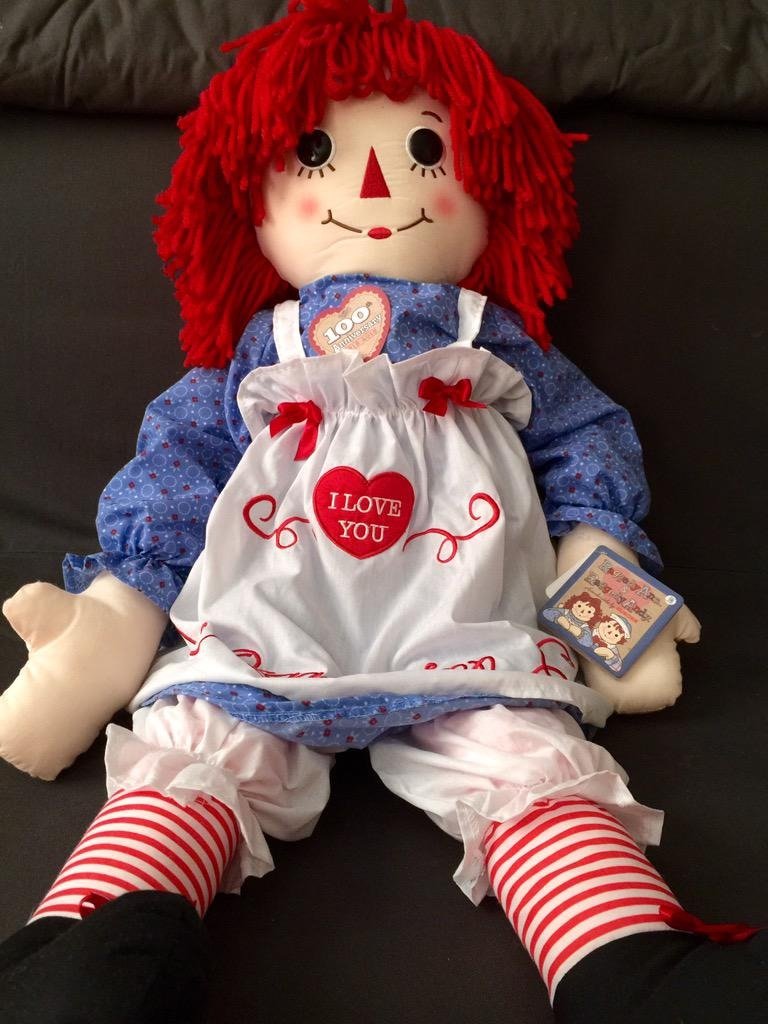
- Label or stamp. Read every line, including country of origin and maker.
- Heart. Feel for a hard insert under the chest fabric; printed or embroidered hearts appear on modern dolls.
- Face. Collector guides use nose outlines and face printing to separate Georgene and Knickerbocker dolls, but the museum records cited here do not describe those traits.
- Box and paper. A printed card box, like the V&A’s 1973 example, can carry the maker’s name even when the cloth tag is gone.
- Safety label. A permanent tracking label means the doll was made for the U.S. market after August 14, 2009.
That last check works for any children’s toy. Our guide to vintage stuffed sheep toys explains the CPSC tracking-label rule in more detail.
The UNT Libraries exhibit notes that a cardboard heart discolored the fabric chest of its own doll. A faint stain over the heart is consistent with an early insert, though it proves nothing on its own.
Why Raggedy Ann Belongs in a Museum
Raggedy Ann entered the National Toy Hall of Fame at The Strong in 2002, and Raggedy Andy joined in 2007. The museum describes the books and dolls as popular for the past century.
Other Hall of Fame toys get the same record-checking treatment in our look at toy invention stories. For Raggedy Ann, the honor recognizes the character rather than any one maker.
That is the useful lesson for collectors. The name stayed the same for more than a century, while the companies changed, so the maker is the date.
Sources
- The Strong National Museum of Play, National Toy Hall of Fame, “Raggedy Ann,” museumofplay.org.
- The Strong National Museum of Play, “Doll: Raggedy Ann,” P.F. Volland Company, 1920–1925, via Google Arts & Culture, artsandculture.google.com.
- The Strong National Museum of Play, “Picture: Fabric Raggedy Ann and Andy 3-D Picture,” 109.14764, via Google Arts & Culture, artsandculture.google.com.
- Victoria and Albert Museum, Character doll, Knickerbocker Toy Co., 1973, MISC.12&A-1974, collections.vam.ac.uk.
- U.S. Patent Office, John B. Gruelle, Design for a Doll, USD47789, 1915, patents.google.com.
- PBS, Antiques Roadshow, “Appraisal: Volland Raggedy Ann & Andy, ca. 1915,” pbs.org.
- PBS, Antiques Roadshow, “Web Appraisal: Raggedy Ann & Andy Dolls, ca. 1965,” pbs.org.
- University of North Texas Libraries, “Fun and Games: Raggedy Ann & Andy,” exhibits.library.unt.edu.
- Chief Marketer, “Raggedy Ann Celebrates Milestone Birthday, Licensing Deal,” 2005, chiefmarketer.com.
- U.S. Consumer Product Safety Commission, “CPSC to Enforce New CPSIA Requirements for Children’s Products Effective August 14,” 2009, cpsc.gov.
Comments (0)