Toy inventor Eddy Goldfarb made his name with a set of wind-up false teeth. Yakity Yak Talking Teeth reached the New York toy show in 1949. A career of nearly 300 patents followed, according to the US Patent and Trademark Office.
Goldfarb never ran a toy company. Like several figures in our stories behind great toy inventions, he invented, built prototypes, and licensed the results to manufacturers. That makes his patents the clearest record of what he designed, and this profile follows them from the teeth to KerPlunk.
From a Submarine to a Sketchbook
Goldfarb was born in Chicago in 1921 to Jewish immigrants from Romania and Poland. He enlisted in the Navy in 1942, and the USPTO’s profile says he served as a radio technician aboard the submarine USS Batfish from 1943 to 1945.
Sources describe the job slightly differently. A 2023 Yahoo Entertainment profile says he operated radar and sonar systems, while the USPTO calls him a radio technician. Both agree that he kept sketching inventions at sea and came home determined to work for himself.
“I’ve always wanted to be an independent inventor.”
Eddy Goldfarb, quoted by the USPTO in “Legacy, love, loyalty, and laughter,” 2023
Yakity Yak Talking Teeth and How They Work
The idea that launched Eddy Goldfarb’s toys was a gag. Yahoo Entertainment reports that he modeled his prototype on a set of false teeth from his dentist.
His patent, filed on November 24, 1948, and granted on April 18, 1950, is titled “Novelty and amusement device.” It aims to simulate “the opening and closing of the teeth of the mouth in rapid succession.” The effect is the illusion of a person “jabbering or speaking rapidly.”
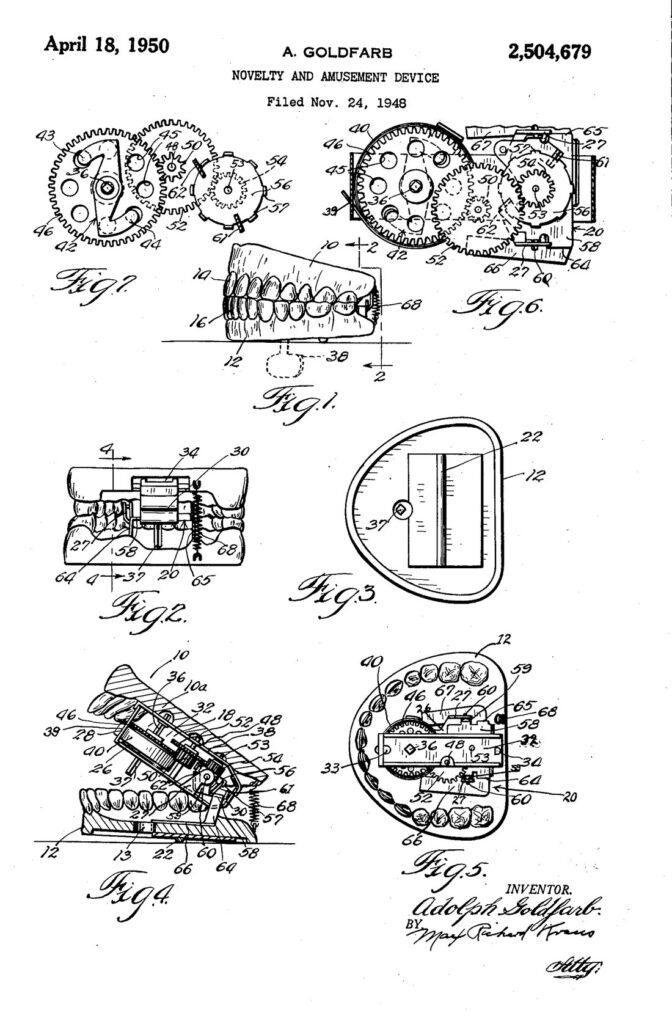
The mechanism is simple and clever. The patent describes it in four parts:
- Two plastic plates shaped like dental plates, with white teeth molded into flesh-colored gums.
- A spring-wound motor fixed inside the roof of the upper plate.
- A hinge that lets the motor snap the upper plate open and shut until the spring runs down.
- A rib under the lower plate, which makes the whole set rock and creep forward while the teeth click.
That last detail is what made the teeth walk across a table. The patent was assigned to H. Fishlove & Co. of Chicago, the novelty firm that sold the toy.
The $900 lesson
The money went elsewhere. The USPTO says Chicago toy promoter Marvin Glass brought the teeth to Irving Fishlove, who bought them for $2,500, and Goldfarb received $900.
Goldfarb regretted selling outright. From then on, according to the USPTO, he vowed to license his inventions instead, keeping a royalty on every unit sold.
Eddy Goldfarb Toys and Their Patents
The licensing model explains how one person could reach so many toy shelves. Goldfarb moved to California in 1952 and kept filing patents for decades, often under his legal name, Adolph E. Goldfarb.
| Talking teeth | US 2,504,679, filed 1948, granted 1950, assigned to H. Fishlove & Co. |
| Fowl toy | US 2,479,488, “Toy which is actuated to simulate the actions of a fowl,” granted 1949 |
| Water gun | US 2,877,931, filed 1955, granted 1959 |
| Marble game | US 3,578,320, “Game structure and method,” with Rene Soriano, granted 1971 |
| Inventor name | Adolph E. Goldfarb on most US filings |
KerPlunk and the marble patent
KerPlunk came out of Goldfarb’s work with Rene Soriano. Players pull sticks from a clear tube one at a time, trying not to let the marbles resting on them fall.
The patent filed on February 19, 1968, describes exactly that. It claims a transparent upright conduit, removable rods forming a barrier, and marbles that drop when a rod is pulled. It names both Goldfarb and Soriano as inventors.
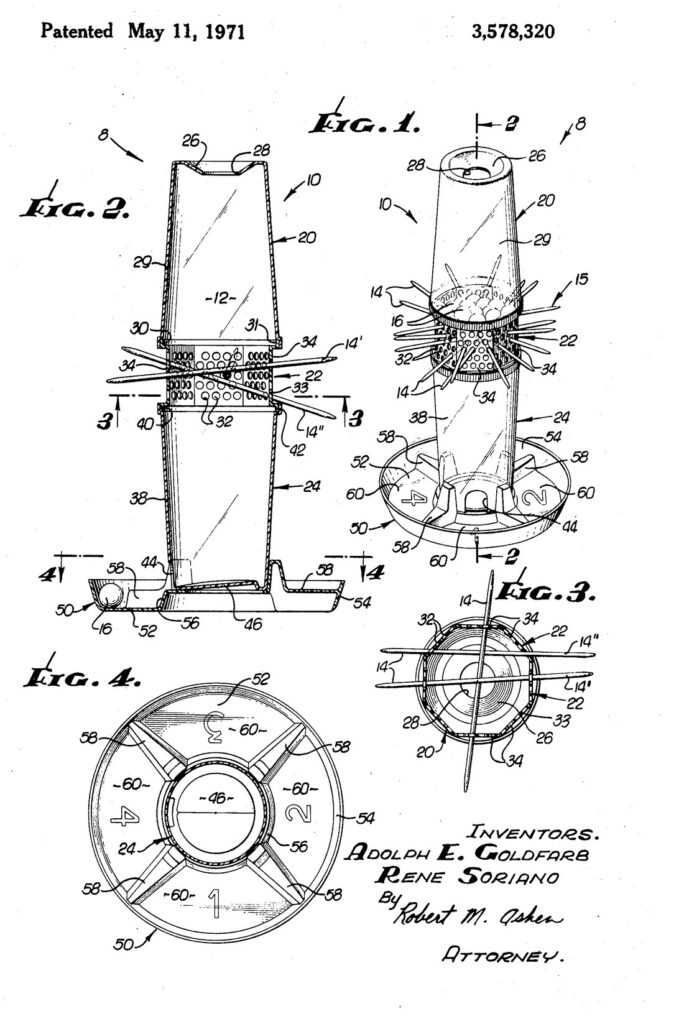
The USPTO says KerPlunk was originally marketed by the Ideal Toy Company, the Brooklyn firm born from the first teddy bear craze. Yahoo Entertainment says Goldfarb licensed it to Mattel. The patent itself names no company, so we leave the question open until a dated box or contract settles it.
Stompers, Battling Tops, and the Bubble Gun
Other hits came through the same route. The USPTO credits Goldfarb with Battling Tops, the Giant Bubble Gun, and Stompers. Stompers, a motorized truck and track set, debuted in 1980 and sold millions of units.
Stompers nearly failed. The USPTO says the first licensee returned it, and Schaper Toys then took it on with Goldfarb’s design and engineering help.
On vintage packaging, look for small patent numbers or “Pat. Pend.” marks near the maker’s name. Matching that number on Google Patents can confirm whether a toy came from Goldfarb’s workshop and narrow its production date.
How Many Toys Did Goldfarb Invent?
Goldfarb is credited with roughly 800 toys and nearly 300 patents, though the totals shift with the source. The USPTO says nearly 300 patents, while Yahoo Entertainment reports more than 800 inventions and 300 patents.
The Toy Book, a trade publication, put it differently in 2021: nearly 800 of his products brought to market. It also lists his 2003 induction into the Toy Industry Hall of Fame and a 2010 TAGIE Lifetime Achievement Award.
Why Goldfarb Belongs Among Famous Toy Inventors
Most famous toy inventors are remembered for one product. Goldfarb’s record is wider, with novelties, water guns, games, and motorized sets, and his patent filings run from 1946 into the 1970s and beyond.
His real legacy may be the business model. Selling the teeth for $900 taught him to keep a stake in every idea. The USPTO says he licensed rather than sold for the rest of his career.
“When one of our games sold a million units… we knew that a million families were together playing that game.”
Eddy Goldfarb, quoted by the USPTO
For collectors, the lesson is practical. Start with the patent, then find the box.
Sources
- US Patent and Trademark Office, “Legacy, love, loyalty, and laughter,” Journeys of Innovation, 2023, uspto.gov.
- Yahoo Entertainment, “Chattering teeth, Bubble Gun, KerPlunk: At 102, toy inventor Eddy Goldfarb is still dreaming up ideas,” 2023, yahoo.com.
- The Toy Book, “Legendary Toy Inventor Eddy Goldfarb Appears on the Power Kid Podcast,” 2021, toybook.com.
- Google Patents, US2504679A, “Novelty and amusement device,”, patents.google.com.
- Google Patents, US2479488A, “Toy which is actuated to simulate the actions of a fowl,”, patents.google.com.
- Google Patents, US2877931A, “Water gun,”, patents.google.com.
- Google Patents, US3578320A, “Game structure and method,”, patents.google.com.