
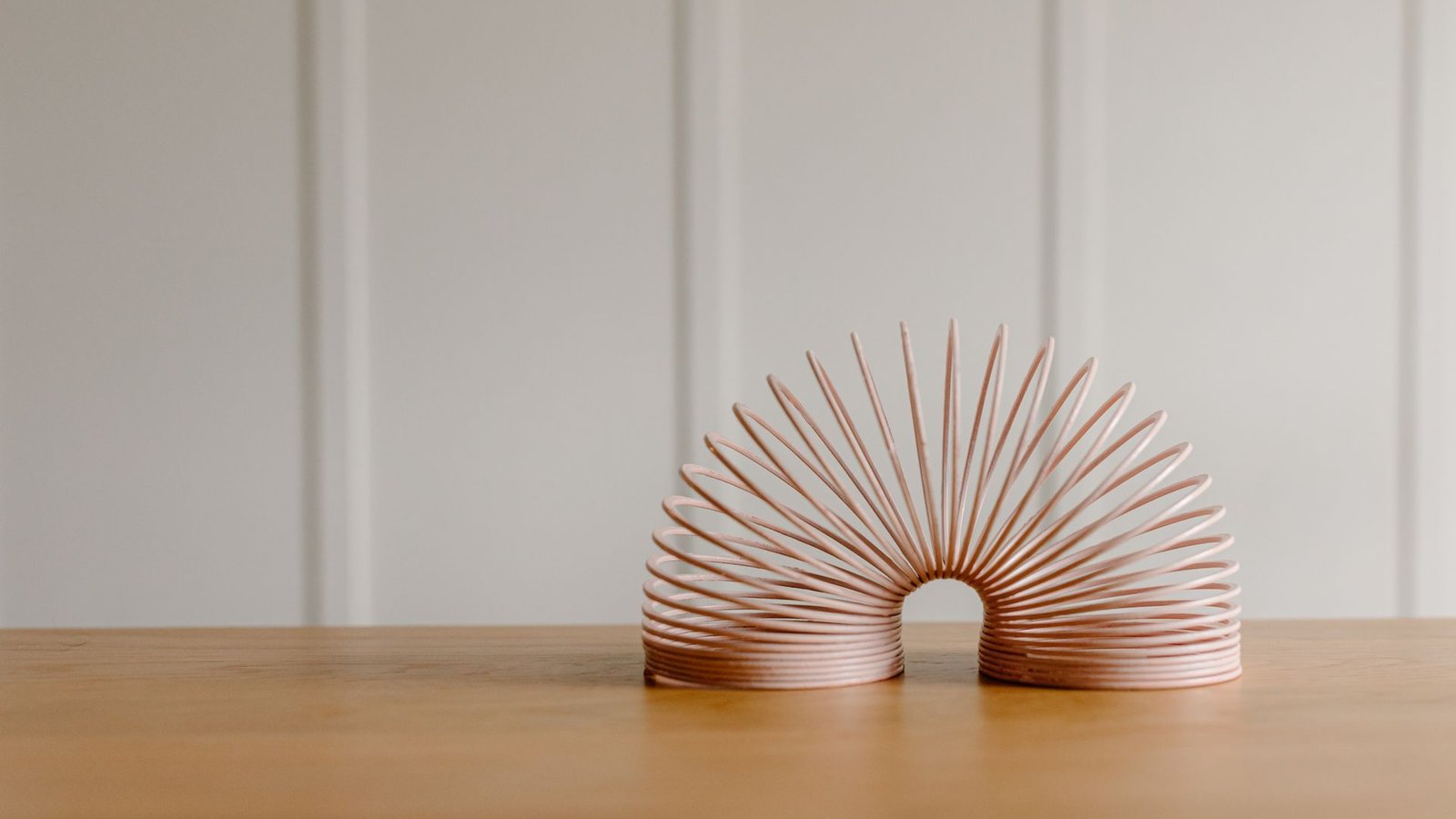
Toys have some of the most amazing stories behind great inventions, because so many began as a fix for something else. A ship spring, a hotel foundation, a light-switch decal, and a heat pump nozzle all ended up in toy boxes.
The phrase itself comes from a book by Don L. Wulffson, Toys!: Amazing Stories Behind Some Great Inventions. Henry Holt published it in 2000, with illustrations by Laurie Keller.
This article checks five famous toy inventions against two records: the patent and the National Toy Hall of Fame at The Strong National Museum of Play. Where they disagree, we say so. Soft toys have their own origin story, told in our teddy bear history and our guide to who invented teddy bears.
Five Famous Toy Patents at a Glance
Patents are the paper trail of toy history. They give a named inventor, a filing date, and a drawing, which makes them harder to embellish than a retold anecdote.
| Toy | US patent | Filed | Granted | Name on the patent |
|---|---|---|---|---|
| Lincoln Logs | 1,351,086 | January 8, 1920 | August 31, 1920 | John Lloyd Wright |
| Slinky | 2,415,012 | August 21, 1946 | January 28, 1947 | Richard T. James |
| Frisbee (design) | D183,626 | July 22, 1957 | September 30, 1958 | Walter Frederick Morrison |
| Etch A Sketch | 3,055,113 | July 23, 1959 | September 25, 1962 | Arthur Grandjean |
| Super Soaker | 4,591,071 | October 14, 1983 | May 27, 1986 | Lonnie G. Johnson |
Read the last column twice. Four names match the inventors in the museum’s stories, and one does not.
Lincoln Logs: An Earthquake-Proof Hotel, Shrunk
John Lloyd Wright got the idea while watching workers build one of his father’s designs, an earthquake-proof building in Japan. The Strong says his toy logs were notched at both ends so children could build structures sturdy enough for rough play.
His patent, titled “Toy-cabin construction,” was filed on January 8, 1920, and granted that August. The Strong dates the toy’s appearance in stores to 1924. Here the patent came four years before the product reached shelves.
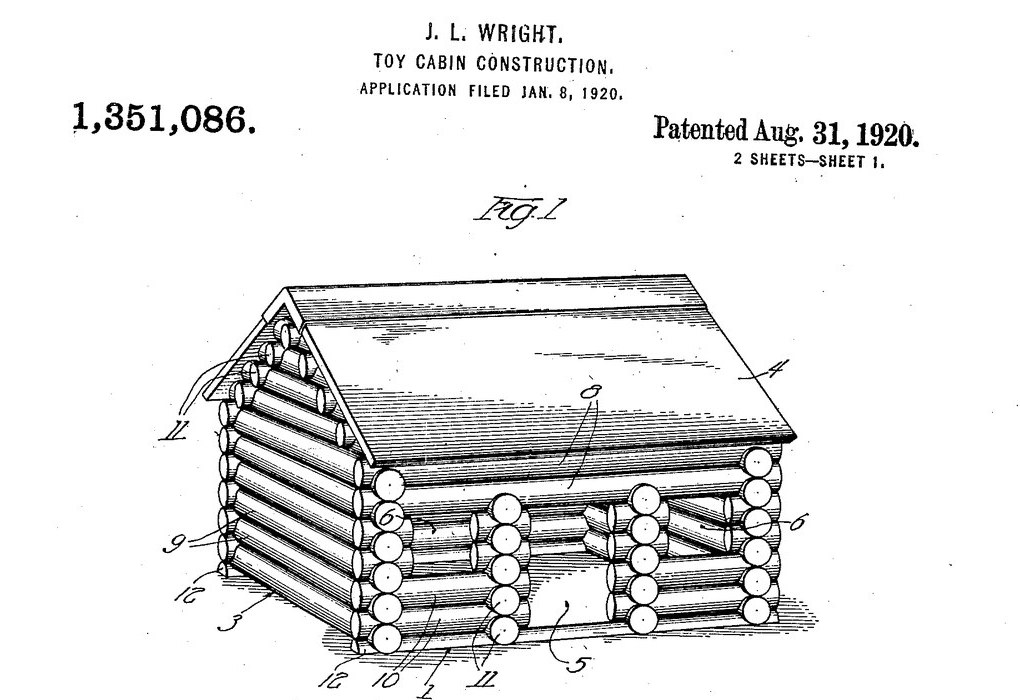
The name was a marketing decision. Wright tied the toy to Abraham Lincoln’s childhood cabin, and the museum notes he refused advertisers’ requests to picture the toy itself on the box.
Slinky: A Spring That Walked Off a Shelf
Richard James was a mechanical engineer working on springs to keep sensitive ship equipment steady at sea in 1943. After knocking samples off a shelf, he watched one “walk” down instead of falling, according to The Strong.
His wife Betty found the name in a dictionary. The couple borrowed $500 to make the first batch, and sales were slow until Gimbels in Philadelphia allowed a demonstration for Christmas 1945.
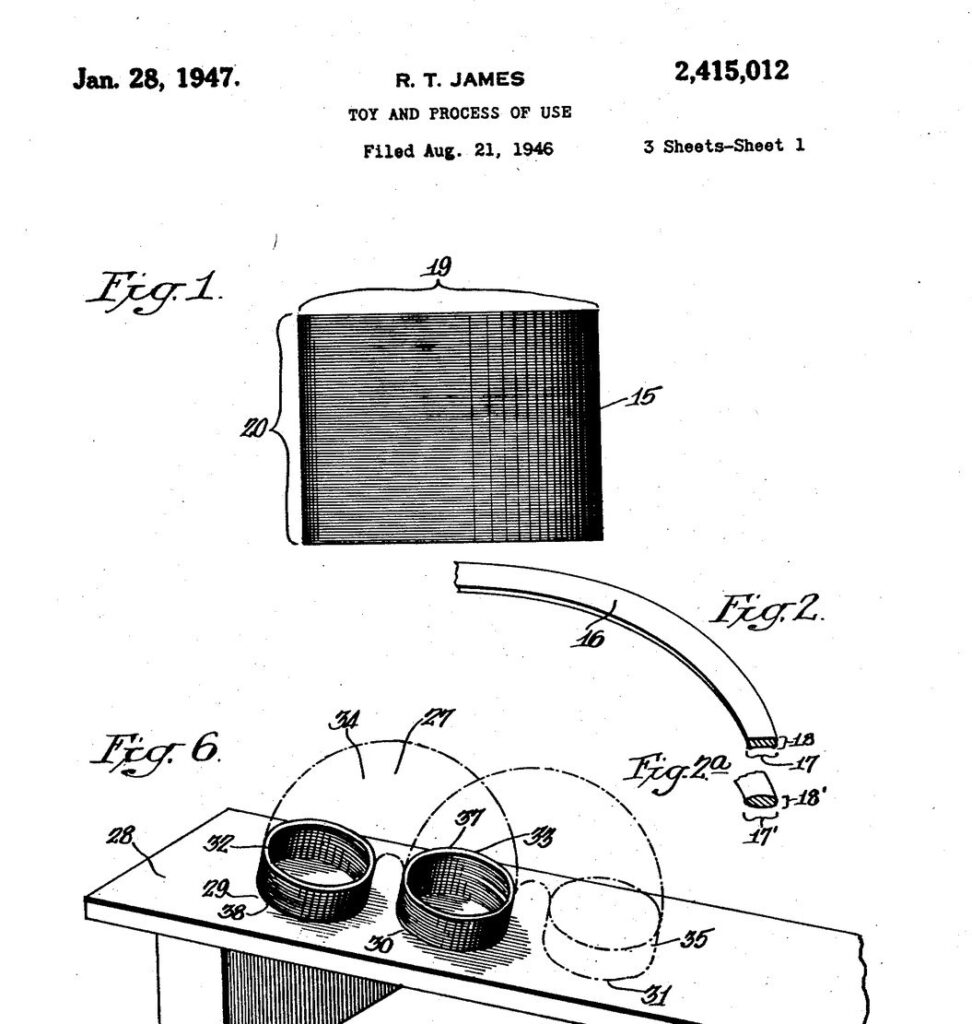
The sources agree on the 400 toys sold that day and differ on the speed. The Strong says “within minutes,” while Smithsonian Magazine says they sold out in under two hours at $1 each. The patent, granted January 28, 1947, is titled simply “Toy and process of use.”
Frisbee: A Pie Tin Legend and a Plastic Patent
The Frisbee began as a game before it was a product. The Strong records that Yale students and others in New England tossed pie tins from the Frisbie Baking Company of Bridgeport, Connecticut.
In 1948 Walter Morrison and his partner Warren Franscioni made a plastic version to sell at county fairs. Morrison called it the “Flying Saucer,” then the “Pluto Platter,” and Wham-O bought the rights in 1955 before renaming it Frisbee in 1958.
The design patent tells a narrower story. It names Morrison alone, under the plain title “Flying toy,” so Franscioni’s part in the 1948 version appears only in the museum’s account.
Etch A Sketch and the Name on the Patent
The Strong credits French electrical technician André Cassagnes, who called his drawing toy L’Ecran Magique, the magic screen. The US patent for the device, granted in 1962, names Arthur Grandjean as its inventor. Both records are real, and they answer different questions: who made the toy work, and who filed for its legal protection.
The museum’s account of the sale is just as specific. The toy drew little interest at the 1959 Nuremberg Toy Fair. Then the Ohio Art Company paid $25,000 for the license, more than it had ever paid before.
Ohio Art renamed it Etch A Sketch, and television advertising made it a must-have toy for Christmas 1960. Inside, static holds a mix of aluminum powder and tiny plastic beads to the back of the screen, and a stylus scrapes lines through it.
Super Soaker: A Heat Pump Experiment
Lonnie Johnson was a mechanical and nuclear engineer working on NASA’s Galileo mission to Jupiter in the early 1980s. At home, he was building a heat pump that used pressurized water instead of Freon.
When he hooked a test nozzle to his bathroom faucet, the stream shot across the room. The Strong says he then built a model from PVC pipe and a soda bottle, which he called the Power Drencher.
“Larami’s aggressive advertising sold 27 million Super Soakers at $10 each in the first three years of production.”
The Strong National Museum of Play, National Toy Hall of Fame entry for the Super Soaker
The toy went on sale in 1990 through Larami Corporation. The museum puts later sales by Larami and Hasbro at about 200 million units, worth roughly $1 billion.
How Are Toys Invented, Then?
Toys are usually invented by people solving a different problem first, then licensing the result to a company that can manufacture and advertise it. Four of the five stories here start outside the toy industry, in naval engineering, architecture, electrical work, and spacecraft research.
The patents show a second step that the anecdotes skip. A working idea had to be filed, drawn, and claimed, and then sold to firms such as Ohio Art, Wham-O, and Larami. Independent inventors such as toy inventor Eddy Goldfarb built whole careers on that licensing step.
- The spark is often accidental, as with the falling spring and the bathroom nozzle.
- The patent turns that spark into property, with a named inventor and a filing date.
- The license puts the idea in front of buyers, as Ohio Art’s $25,000 deal shows.
- The marketing decides the name, from Pluto Platter to Frisbee and Power Drencher to Super Soaker.
Patent numbers and dates are printed on many vintage toys and their packaging. A “Pat. Pend.” mark on a toy means it was made after filing and before the grant, which can narrow the production window for an early example.
The Stories Behind the Stories
Every toy here has a tidy origin anecdote, and every one of them needs a footnote. The Slinky’s selling speed, the Frisbee’s second founder, and the Etch A Sketch’s patent name all shift depending on the record you open.
The soft-toy world has the same problem, which is why we trace who invented the first stuffed animal through company archives instead of retold legend. For any famous toy, the patent is the first document to check and the last one to argue with.
Sources
- The Strong National Museum of Play, National Toy Hall of Fame, “Lincoln Logs,”, museumofplay.org.
- The Strong National Museum of Play, National Toy Hall of Fame, “Slinky,”, museumofplay.org.
- The Strong National Museum of Play, National Toy Hall of Fame, “Frisbee,”, museumofplay.org.
- The Strong National Museum of Play, National Toy Hall of Fame, “Etch A Sketch,”, museumofplay.org.
- The Strong National Museum of Play, National Toy Hall of Fame, “Super Soaker,”, museumofplay.org.
- Smithsonian Magazine, “The Accidental Invention of the Slinky,” 2019, smithsonianmag.com.
- Google Patents, US1351086A, “Toy-cabin construction,”, patents.google.com.
- Google Patents, US2415012A, “Toy and process of use,”, patents.google.com.
- Google Patents, USD183626S, “Flying toy,”, patents.google.com.
- Google Patents, US3055113A, “Tracing device,”, patents.google.com.
- Google Patents, US4591071A, “Squirt gun,”, patents.google.com.
- Wake County Public Libraries catalog, Toys!: Amazing Stories Behind Some Great Inventions, Henry Holt, 2000, catalog.wakegov.com.
1 thought on “Toys and the Amazing Stories Behind Great Inventions”