
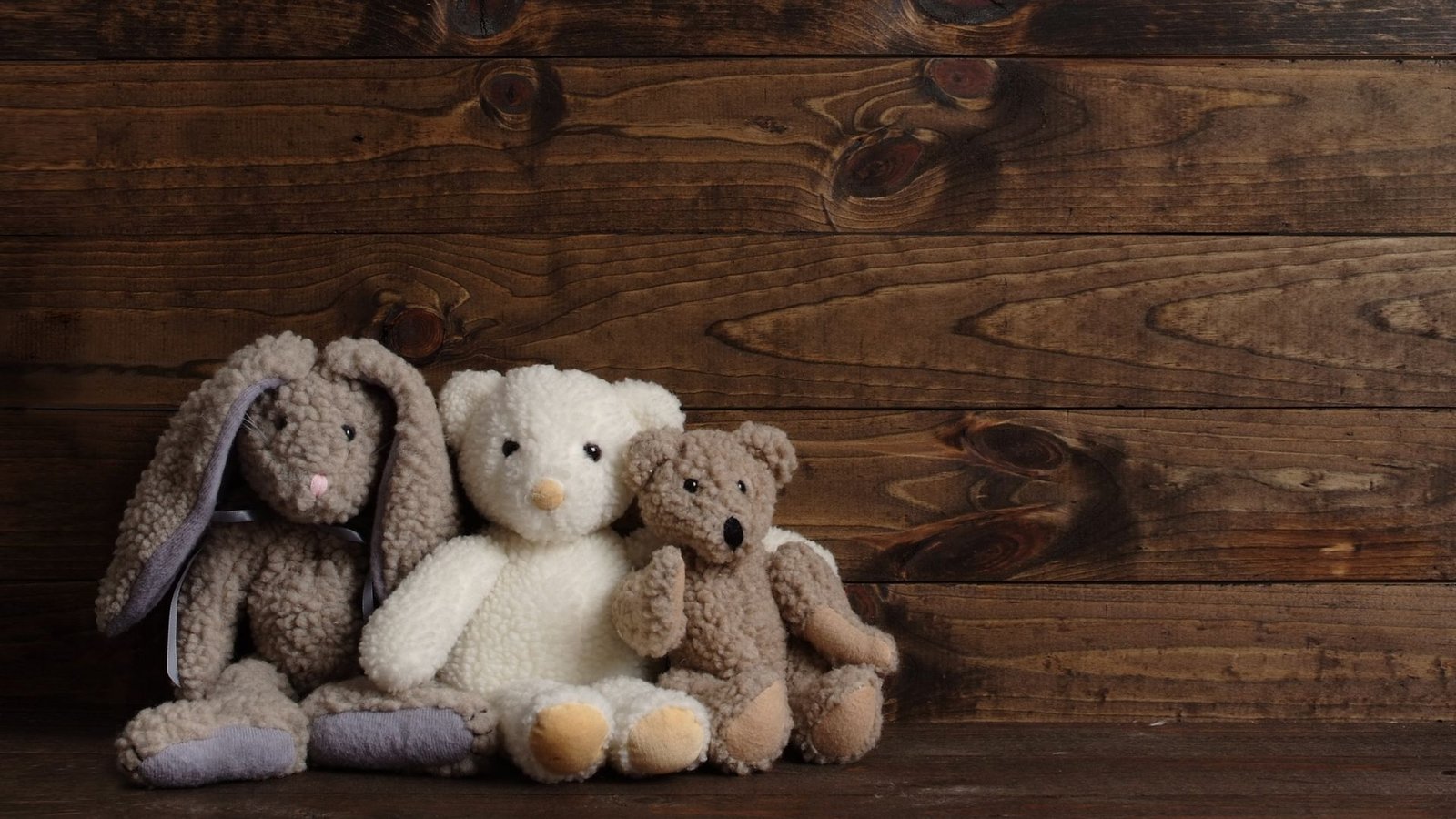
The answer to when was the first soft toy made depends on what you count. Cloth dolls stuffed with papyrus survive from Roman Egypt, around AD 200 to 400.
If you mean a soft toy animal made for sale, Steiff’s company history points to a felt elephant sewn in Germany in 1880. A plush toy in the strict sense came later, in 1902, with the jointed mohair bear that started the teddy craze. Anyone asking when soft toys were invented should expect more than one honest date.
When Was the First Soft Toy Made?
The oldest soft toys on record are Roman-era cloth dolls from Egypt. The Victoria and Albert Museum dates one to about AD 200 to 400. The first soft toy animal sold as a product dates to 1880, when Margarete Steiff sewed a felt elephant.
Then came the first jointed plush bear in 1902. So the honest reply has three parts:
- About AD 200 to 400: the oldest surviving stuffed cloth dolls, from Oxyrhynchus in Egypt.
- 1880: the first soft toy animal sold as a product, by Steiff’s own company history.
- 1902: the first plush bear with movable arms and legs, Steiff’s Bear 55 PB.
A Papyrus-Stuffed Doll From Roman Egypt
The V&A holds a small doll made at Oxyrhynchus, a town in Roman Egypt. Its catalog record (1937-1897) describes an outer layer of undyed linen with a band of red wool around the waist. The doll is stuffed with papyrus, and strands of hair remain on its head.
That makes it a soft toy in the most literal sense: woven cloth wrapped around a soft filling. It is missing an arm, and the record notes some staining.
Survival is the catch. Egypt’s dry sand preserves textiles that rotted almost everywhere else, so these dolls are the oldest we can see, not necessarily the oldest ever sewn. The longer history of stuffed animals picks up the thread between Rome and the toy factories.
When Soft Toys Became Products
1880: Margarete Steiff’s felt elephant
Steiff’s corporate history names 1880 as its founding year. That year Margarete Steiff sewed a small felt elephant, the “Elefäntle,” from a pattern in a fashion journal. It caught on as a children’s toy, and a catalog of felt animals followed.
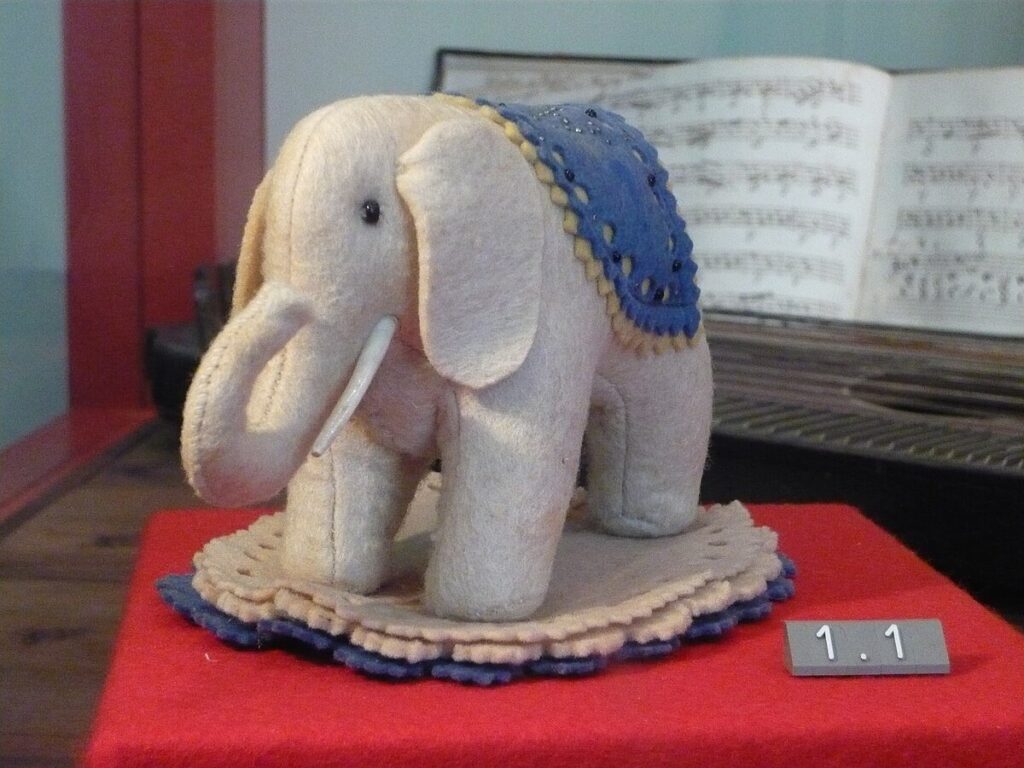
Her firm was entered in the commercial register on March 3, 1893, as a felt toy factory. By Steiff’s count it had four seamstresses and ten home workers that year. The toys made their debut at the Leipzig Toy Fair the same year, which is the first sign of a trade rather than a craft.
1902: Plush enters the picture
Felt is a pressed wool sheet. Plush is a woven fabric with a raised pile, and mohair plush gave toys their fur-like surface.
Steiff’s bear timeline decodes the name of its 1902 Bear 55 PB. The 55 is its standing height in centimeters, P stands for “Plüsch,” and B for “beweglich,” or movable.
Ask what was the first plush toy ever made, and this bear has the strongest documented claim. Earlier rivals for the title were made of felt or plain cloth, which have no pile at all.
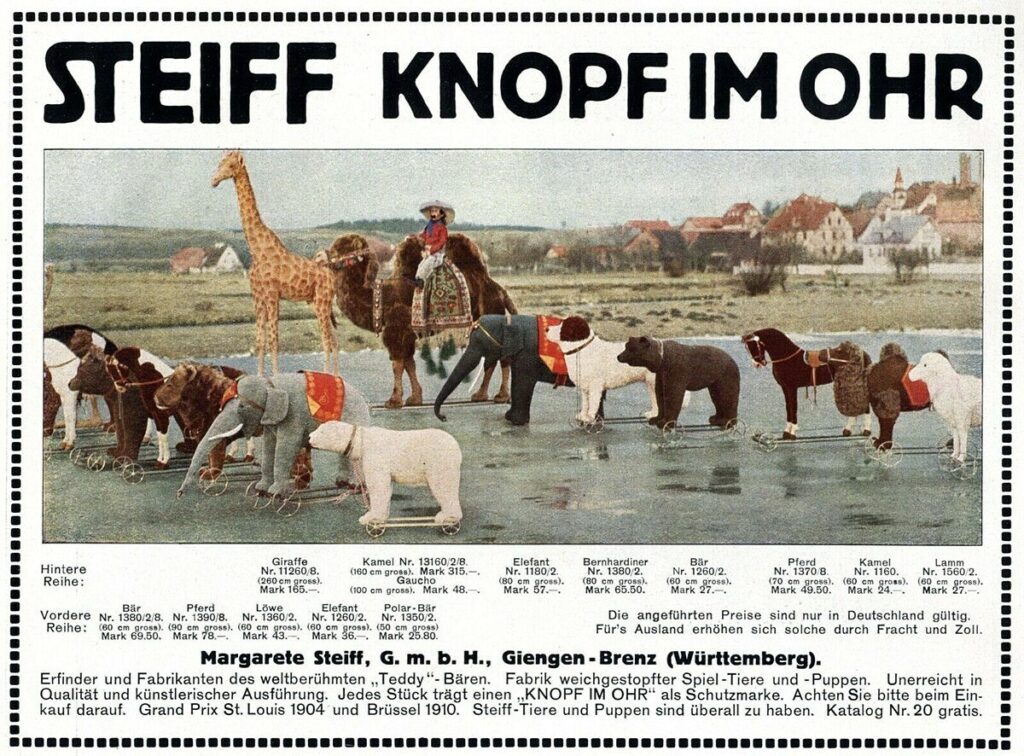
By 1913 the firm had a phrase for what it made. Its “Knopf im Ohr” advertisement from that year describes Steiff as a factory of “weichgestopfter Spiel-Tiere und -Puppen,” softly stuffed toy animals and dolls.
Steiff says none of the 3,000 Bear 55 PB toys ordered at Leipzig is known to survive. Treat any listing for an “original 1902 55 PB” with deep suspicion, and ask whether it is one of the company’s later replicas.
Soft Toy, Plush, or Stuffed Animal: Three Names
The three labels overlap, and they did not arrive together. Merriam-Webster’s entries show where each one sits.
| Term | What the dictionary says | Dating |
|---|---|---|
| Plush | A fabric with an even pile that is longer and less dense than velvet pile, from Middle French “peluche” | First known use 1590, as a noun |
| Soft toy | British term for a toy animal with fake fur and soft filling | No first-use date given |
| Stuffed animal | US term, same definition as soft toy | No first-use date given |
The fabric name is four centuries old. The toy names are regional twins, and we did not find a dated first use for either phrase in a source we would cite.
Britain also produced its own branch of the story. The V&A records that Dean’s Rag Book Company was formed in 1903 to print children’s books on cloth. Dean’s later sold printed rag dolls flat on sheets, to be sewn at home, and patented them in 1908.
Why the Date You Choose Matters
A seller who calls a toy “one of the first soft toys” is making a claim about definitions as much as age. Ask which first they mean: the first stuffed cloth figure, the first sold animal, or the first plush one.
For collectors, 1880 and 1902 are the dates that carry weight, because both are backed by a company archive. When did they start making plush toys at scale? Steiff’s 1907 output of 973,999 teddy bears suggests the answer is within five years of that first plush prototype.
Sources
- Victoria and Albert Museum, “Doll,” Oxyrhynchus, ca. AD 200–400, 1937-1897, collections.vam.ac.uk.
- Victoria and Albert Museum, Dean’s Rag Book Company doll record, B.130-2010, collections.vam.ac.uk.
- Margarete Steiff GmbH, “From the past to the present,”, corporate.steiff.com.
- Margarete Steiff GmbH, “Iconic Teddy bears,”, corporate.steiff.com.
- Merriam-Webster, “plush,”, merriam-webster.com.
- Merriam-Webster, “soft toy,”, merriam-webster.com.
- Merriam-Webster, “stuffed animal,”, merriam-webster.com.
2 thoughts on “When Was the First Soft Toy Made? Three Honest Answers”