

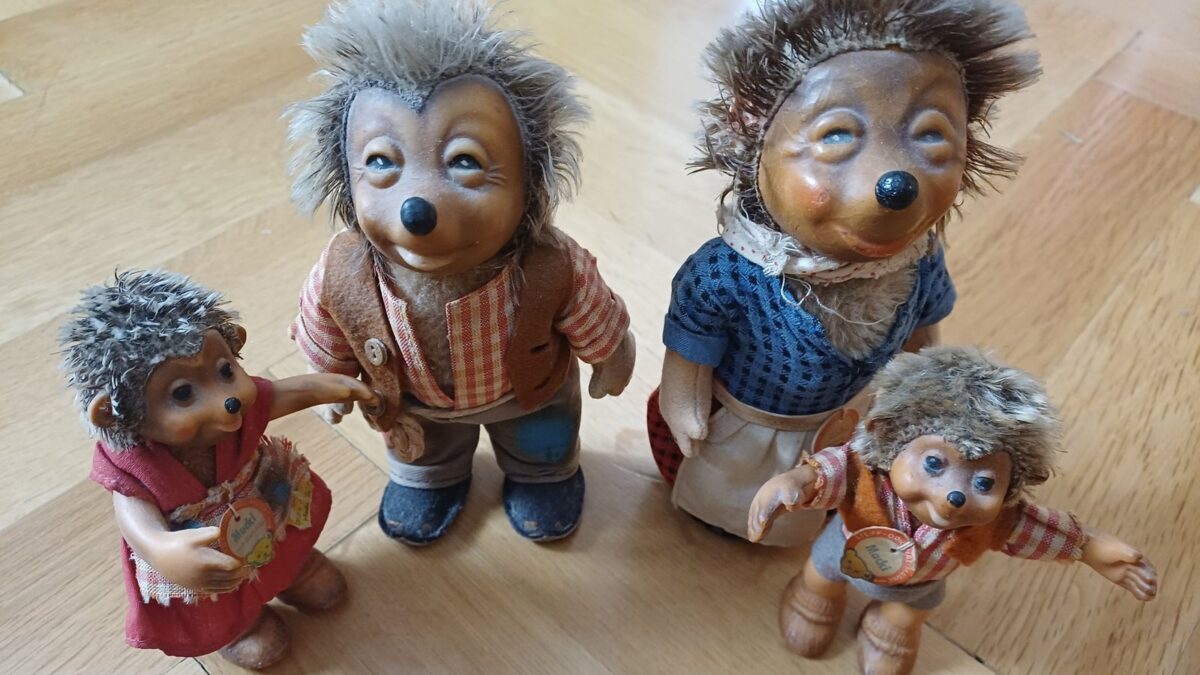
A vintage rubber faced teddy bear pairs a soft plush body with a molded face, usually painted by hand. The style belongs mostly to the 1950s, when several makers sold bears, hedgehogs, and character toys built this way.
Attribution is the hard part. Dealer listings name many companies, but only some of those names hold up against museum records and period reporting. This guide sticks to the makers we could verify and says plainly where the record runs out.
What a Rubber Face Changed on a Plush Toy
The face was usually the only molded part. The body stayed plush and stuffed, so the toy still felt like a teddy bear in the hand.
Our account of how stuffed animals changed after 1945 covers the move to nylon plush, foam, and locked-in plastic eyes. Rubber faces belong to the same postwar shift, though they solved a different problem.
Why Did Makers Give Plush Toys Rubber Faces?
A molded face could carry a character’s exact painted expression, which stitched features on plush could not. That mattered most for licensed characters, mascots, and advertising figures, where buyers expected a recognizable face.
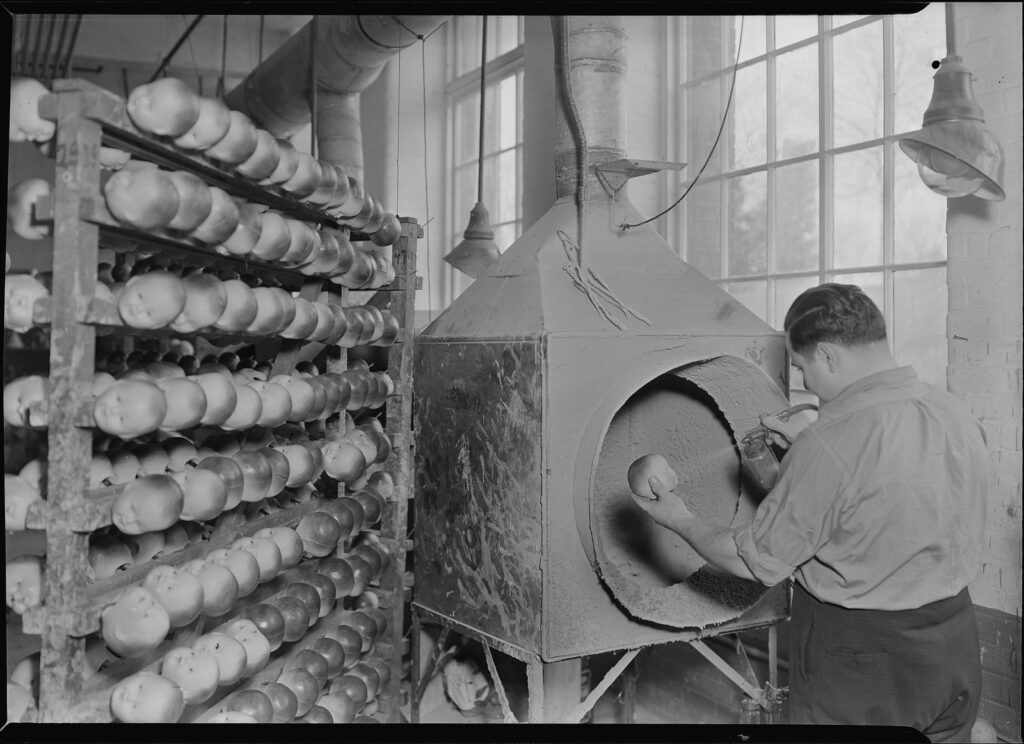
Doll factories had already worked out the process. In 1936 or 1937, photographer Lewis Hine recorded a worker at the Paragon Rubber Co. and American Character Doll plant in Holyoke, Massachusetts, spraying color onto rows of molded doll faces.
Rubber Face Teddy Bear Makers on Record
Steiff and the Mecki family, 1950s
The clearest museum evidence comes from Germany. The Victoria and Albert Museum holds Steiff’s Micki, a hedgehog doll dated 1951 to 1958, and catalogs its face as “light brown rubber.”
Its materials line reads felt, cotton, PVC, and compression moulded rubber. Micki, Mecki, and their children were mascots of the German magazine Hör Zu, according to the V&A, and became very popular with German children after the Second World War.
| Object | Micki, hedgehog doll |
|---|---|
| Maker | Margarete Steiff GmbH, Germany |
| Date | 1951–1958 |
| Face | Light brown rubber |
| Materials | Felt, cotton, PVC, compression moulded rubber |
| Marks | Steiff button on a plastic bracelet, left wrist |
| Museum no. | B.124-2017, V&A |
Steiff used the same approach on other figures. The V&A’s Lucki, a gnome dated 1953 to 1958, has a head that “appears to be made from moulded rubber,” with the Steiff button on a red PVC bracelet.
On these figures the button sits on the wrist, not in the ear. Our guide to popular plush brands explains how Steiff’s button and tags work on its standard plush.
Rushton of Atlanta
Rushton is the American name most tied to rubber faces, and one period object confirms it. Terry and Kim Kovel, the antiques columnists, report that the Rushton Toy Company in Atlanta made Santa Claus dolls for the Coca-Cola Company.
Those Santas have hand-painted rubber faces and hands, according to the Kovels, and Coca-Cola gave them to its bottlers in 1957. The reader’s doll in that column carried a “Rushton Toy Company” stamp on the bottom of its boot.
A maker’s stamp on a rubber part, like the Rushton boot stamp, survives longer than a paper hang tag. Check the soles, the back of the head, and the neck edge before deciding a toy is unmarked.
Gund in the 1950s
Gund’s own collection at The Strong National Museum of Play supports part of the story. The Strong holds a Gund teddy bear dated 1950 to 1959 whose materials include vinyl, and a Gund dog pull toy from the same decade that lists rubber.
Neither record says which part is vinyl or rubber. Treat a “1950s Gund rubber face bear” as plausible, then look for the Gund label before paying for the attribution. Our vintage Gund teddy bear dating guide reads those labels era by era.
Ideal and Smokey Bear, 1952
Ideal, the Brooklyn firm behind one of the first teddy bears of 1903, made the first Smokey Bear stuffed toy in 1952. The date comes from a 1984 Forest Service fire-prevention booklet held by the Forest History Society. Each toy came with a card children could mail in to become a Junior Forest Ranger.
That same booklet says Congress passed the Smokey Bear Act by 1952, letting the Forest Service license the character and collect royalties. That licensing is why a genuine Smokey toy should be an authorized product.
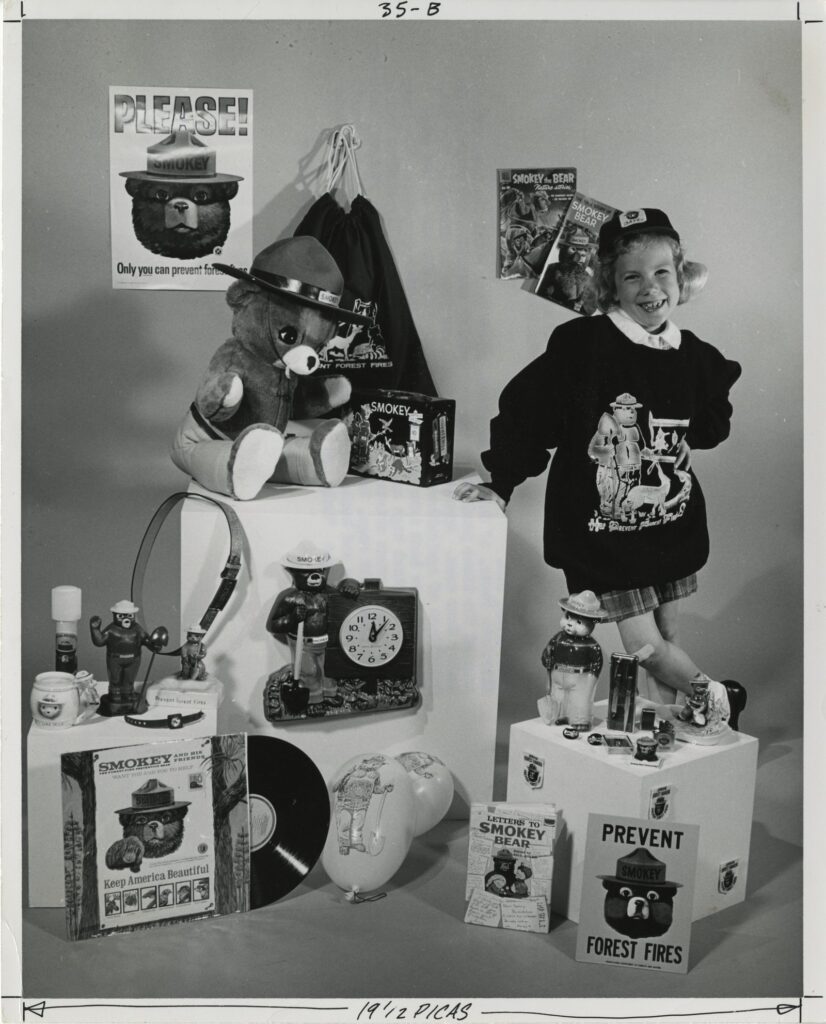
The face material is less certain. Dealer listings mostly describe Ideal Smokeys with rubber faces, while Collectors Weekly’s guide to Smokey collectibles says Bakelite faces and paws. We found no museum record that settles it, so check the specific doll rather than the label “rubber face.”
Makers we left out
Knickerbocker appears often in listings for 1950s rubber-faced bears and monkeys. We could not confirm those toys in a museum record, patent, or period report, so this guide does not attribute any rubber-faced bear to Knickerbocker.
Dating a 1950s Rubber Face Teddy Bear
The museum dates above cluster in the 1950s: Steiff’s Micki at 1951 to 1958, Gund’s bear at 1950 to 1959, Ideal’s first Smokey in 1952 (face material unconfirmed), and Rushton’s Coca-Cola Santa in 1957. A rubber face alone suggests that decade but does not prove it.
- Maker’s mark. A Steiff button on a wrist bracelet, a Gund label, or a Rushton stamp narrows the date fastest.
- Character. Smokey, Mecki, and advertising figures can be dated against the licensing or campaign records behind them.
- Body plush. Nylon or other synthetic plush fits the postwar period better than the mohair of antique teddy bears.
- Tags and cards. A Junior Forest Ranger card points to an early Ideal Smokey, since the Forest Service booklet ties the card to the first toys.
Caring for Aging Rubber Faces
Rubber is the weak point on these toys. The Canadian Conservation Institute says natural rubber is particularly prone to oxidative deterioration from oxygen in the air, and that ozone can cause very rapid damage.
As it ages, rubber may turn brittle, hard, or cracked, or it may soften and become spongy or sticky, according to the institute. It can also change color as the polymer itself changes.
Do not use solvents or even water-based cleaning solutions on rubber and plastics.
Canadian Conservation Institute, CCI Notes 15/1
The CCI recommends dry cleaning by careful brushing or vacuuming, plus cold, dark, dry storage under 150 lux. A cracked or tacky face belongs with a conservator. Our guide on how to clean vintage stuffed animals covers the plush body and flags the cold-storage risk for rubber.
A rubber face records the 1950s more clearly than almost any other part of a plush toy. It also wears out faster, so the toys that still smile back are getting rarer each year.
Sources
- Victoria and Albert Museum, “Micki,” Margarete Steiff GmbH, 1951–1958, B.124-2017, collections.vam.ac.uk.
- Victoria and Albert Museum, “Lucki,” Margarete Steiff GmbH, 1953–1958, B.120:1, 2-2017, collections.vam.ac.uk.
- Terry and Kim Kovel, “‘Make-do’ mirror from a frugal era is prized today,” The Herald (Everett), 2022, heraldnet.com.
- The Strong National Museum of Play, “Stuffed animal: Teddy Bear,” GUND, 1950–1959, 115.993, via Google Arts & Culture, artsandculture.google.com.
- The Strong National Museum of Play, “Stuffed animal: Dog Pull Toy,” GUND, 1950–1959, 115.929, via Google Arts & Culture, artsandculture.google.com.
- U.S. Forest Service, “Remember, Only YOU,” 1984, Forest History Society, foresthistory.org.
- Collectors Weekly, “Smokey Bear Collectibles,” collectorsweekly.com.
- Lewis Hine, Paragon Rubber Co. and American Character Doll, Holyoke, Massachusetts, 1936–1937, U.S. National Archives 518351, commons.wikimedia.org.
- Scott Williams, “Care of Objects Made from Rubber and Plastic,” CCI Notes 15/1, Canadian Conservation Institute, canada.ca.
Comments (0)