
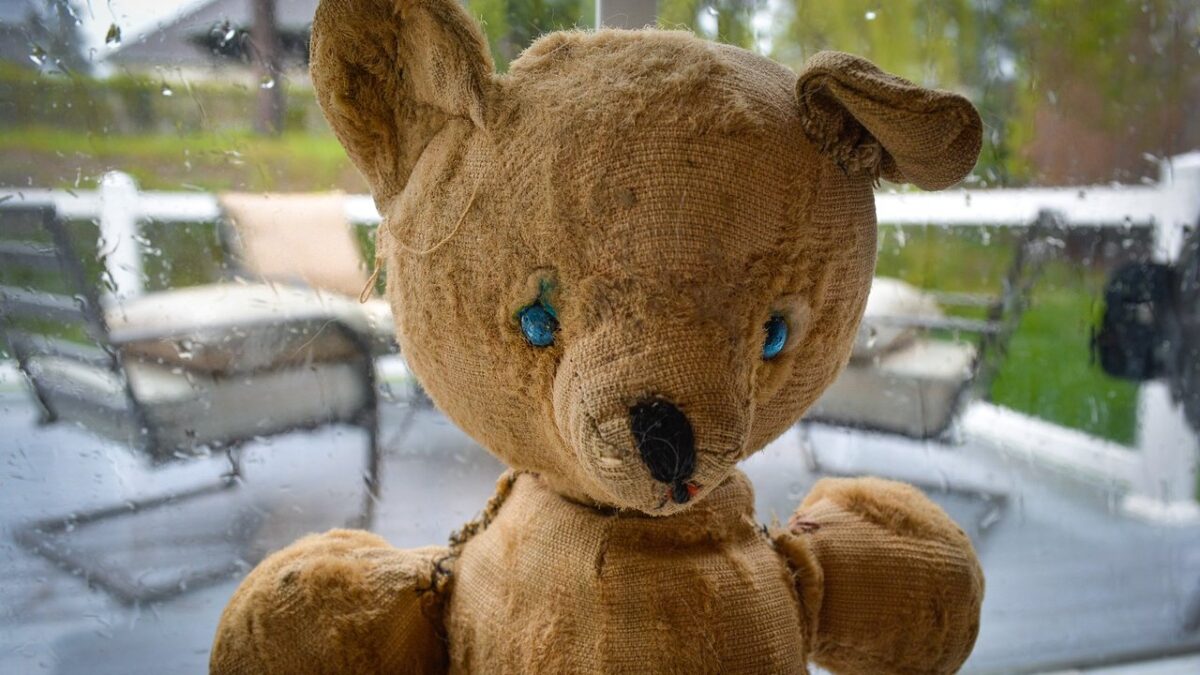
Antique teddy bear identification starts with your hands, not a price guide. The ear, the fur, the fill, the eyes, the shape, and the joints each leave physical evidence that a photo can hide.
This checklist covers bears made before roughly the 1950s, with Steiff as the best-documented reference. If you need the maker-by-maker label guide first, start with our overview of popular plush brands and their marks, then come back with the bear in your lap.
Start at the Left Ear
Steiff put its mark where buyers would look first. The German Patent and Trade Mark Office (DPMA) says Franz Steiff designed the “Button in Ear” in 1904 and that the trademark was registered in 1905.
The V&A records the button in the left ear on its early Steiff bears. Its catalog also sets out the order in which the button changed, which is the most useful single fact for anyone learning how to identify a Steiff bear.
- Before 1904 to 1905: an elephant embossed on the button. The V&A describes it as an elephant with an S-shaped trunk.
- 1904 to 1905: a blank metal button, with no design at all.
- After 1905: the name “Steiff” on the button, in several different styles of lettering over the decades.
That third stage hides a lot of variation. Collector guides describe a Steiff button with an extended, underscored final F and tie it to the first half of the century. We found no museum or company record that dates that lettering, so treat any year attached to it as dealer knowledge until a record says otherwise.
Look at the ear before the button. A clean hole with no matching wear, or a button that sits in fresh fabric, suggests it was added later. An empty ear does not rule a bear out, since buttons were often taken off over a long life.
Fur, Fill, and Eyes
Mohair pile
Most early jointed bears wear mohair plush, a pile fabric woven from Angora goat hair. Part the fur with a fingertip, as lightly as you would when you clean vintage stuffed animals, and look at the backing. Mohair pile stands in tufts on a woven cotton base, and on old bears it often wears down to the weave on the nose, paws, and tummy.
Stuffing you can feel
Squeeze the head, then the body. The V&A’s 1904 to 1905 Steiff bear has wood wool in the head and a mix of wood wool and kapok in the body and limbs. Wood wool, also called excelsior, crackles and resists the press of a thumb.
Kapok feels softer and shifts in small lumps. We trace how fillings changed decade by decade in our piece on stuffed animal evolution throughout the years, so this check stays narrow: a bear sold as pre-war should not squash and spring back like foam.
Boot buttons, glass, and plastic
Early Steiff eyes are black boot buttons. The V&A records them on its 1904 to 1905 bear and on a Steiff bear of about 1920, which shows the style lasted well past the first teddy boom.
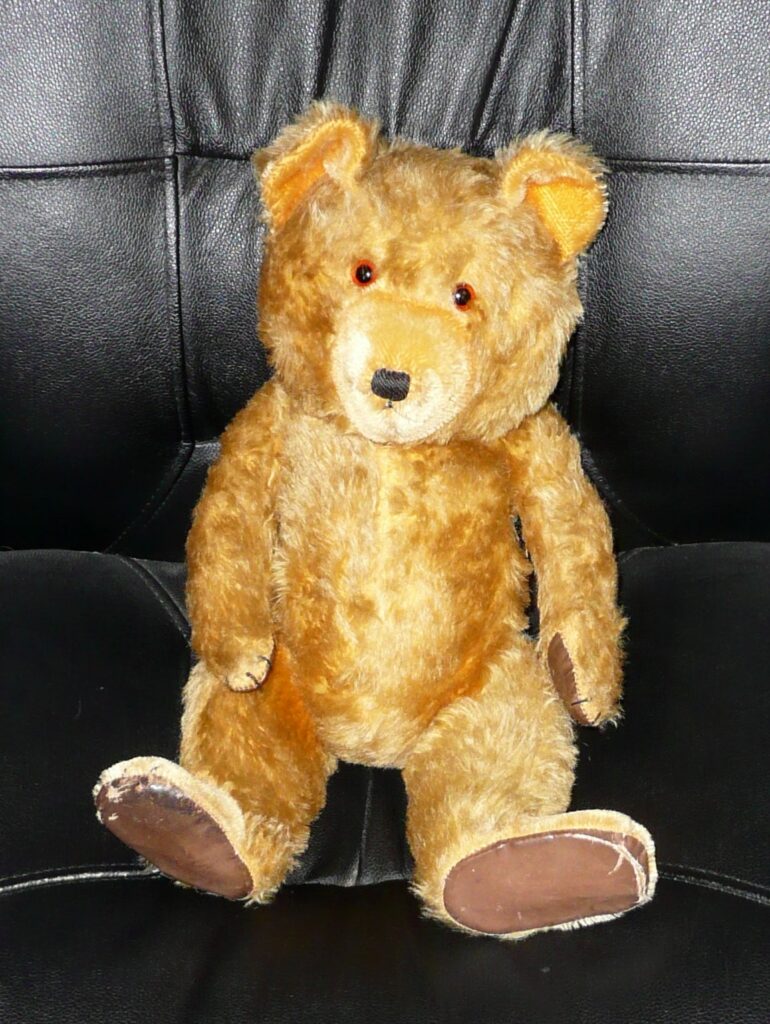
British makers went a different way. The V&A notes that English bears “usually had glass eyes,” citing a 1917 bear by Omega, the trade name of British United Toy Manufacturing. Glass eyes alone therefore do not make a bear younger, only possibly British, while a molded face like those on the rubber-faced bears of the 1950s is a postwar clue.
The Antique Bear Silhouette
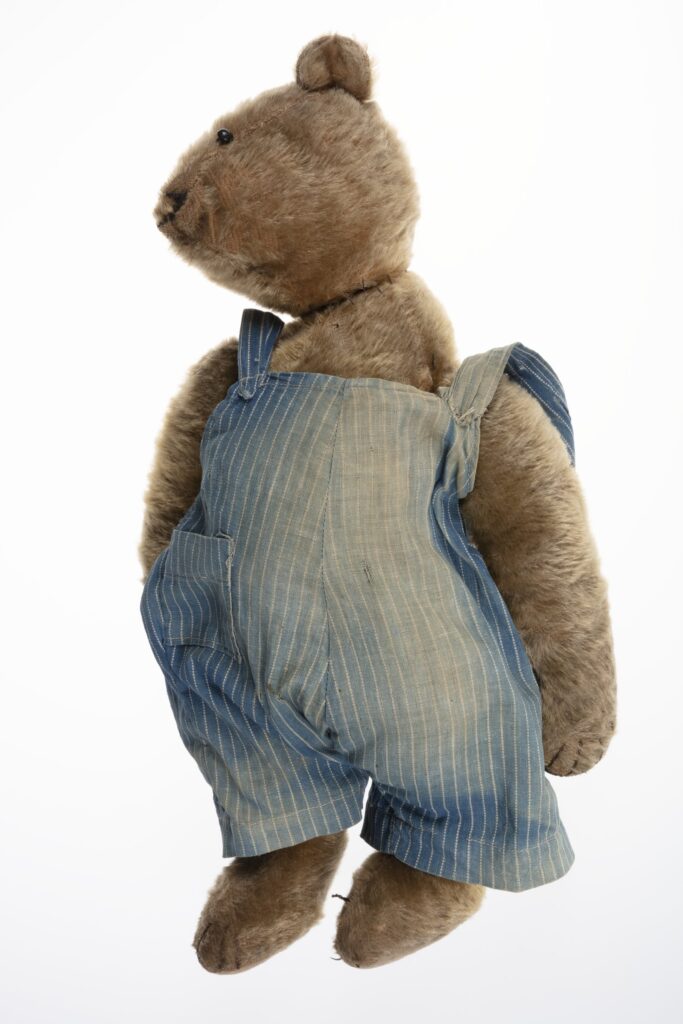
Before you read any tag, stand the bear up and look at it side on. Early bears were cut to look like real bears, and the V&A describes its 1904 to 1905 Steiff in plain anatomical terms.
The arms are long and slender, the legs have plump thighs, slim ankles and narrow feet.
Victoria and Albert Museum, catalog record B.253-2000
The same record notes a humped back and felt pads on the paws and feet. Run a hand down the spine: on many early bears a hump sits just below the neck. Arms usually reach well below the hips and curve inward at the paw.
Felt pads matter because they wear honestly. Old felt thins and gets patched, so pristine pads on a heavily worn body deserve a closer look. The glass-eyed bear pictured earlier has faux-leather pads, a reminder that non-felt pads are not automatically wrong.
| Maker | Omega (British United Toy Manufacturing Co Ltd) |
|---|---|
| Date | 1917 |
| Material | Golden mohair, glass eyes, silk ribbon |
| Construction | Jointed head, arms, and legs; slight hump on the back |
| Marks | None recorded; faint marker on the foot pads |
How Can You Tell if a Teddy Bear Is Antique?
You can tell a teddy bear is antique when several independent physical clues agree, not when one feature looks old. The ear mark, fur, filling, eyes, silhouette, and joints should all point to the same decades. If any one of them contradicts the others, the bear is younger, repaired, or assembled from parts.
Work through the checks in the same order every time:
- Ear: button style, or the holes and wear where a button once sat.
- Fur: mohair pile on a woven backing, worn in the places a child would hold.
- Fill: wood wool that crackles in the head, kapok or wood wool in the body.
- Eyes: boot buttons or glass, set with thread or wire, not a plastic locking back.
- Shape: hump, long curved arms, slim ankles, felt or faux-leather pads.
- Joints: rotation at neck, shoulders, and hips that feels like a disc turning.
Joints and What Holds Them
A fully jointed bear turns at five points: the head, both arms, and both legs. Press gently where the limb meets the body and you will usually feel a firm, flat disc under the fabric.
Steiff described that traditional construction in its own patent. In application DE3338643, filed in 1983, Margarete Steiff GmbH says the limbs of soft toy figures had previously been joined with a cardboard disc in each part, held together by a metal bolt “or the like.” The patent replaced them with plastic discs and a plastic bolt because the old joints loosened in the wash and left rust spots.
That gives you a practical test. Rust stains around the shoulders or hips fit old metal fittings, while a soft, washable joint fits later construction. Collectors usually call the metal fastener a cotter pin, a split pin bent open inside the body.
What Proves Nothing on Its Own
Reproductions copy the style first, because style is the easiest part to copy. Steiff’s own 2024 replica of its 1904 PB 28 bear is stuffed with wood wool and arrives with an elephant button, according to a UK Steiff stockist’s listing. Each of these features can appear on a bear made last year:
- A hump, long arms, and big feet, which modern replicas and artist bears copy on purpose.
- Boot-button eyes, which are easy to source and sew on.
- Faded or worn fur, which can come from heavy use in a single decade.
- An elephant or blank button, which a licensed replica can carry too.
- A family story, which dates the memory, not necessarily the bear.
The museum records are a better model than any single clue. Even the V&A dates its earliest bears in ranges, as we show in our search for the oldest plush in the world with a catalog record. A seller who claims more certainty than a museum catalog should be able to show you why.
Sources
- Deutsches Patent- und Markenamt (DPMA), “Margarete Steiff,” dpma.de.
- Margarete Steiff GmbH, “From the past to the present,” corporate.steiff.com.
- Victoria and Albert Museum, “Teddy bear,” Margarete Steiff GmbH, 1904–1905, B.253-2000, collections.vam.ac.uk.
- Victoria and Albert Museum, “Teddy bear,” Margarete Steiff GmbH, about 1920, MISC.107-1978, collections.vam.ac.uk.
- Victoria and Albert Museum, “Teddy bear,” Omega, 1917, B.143-2010, collections.vam.ac.uk.
- Margarete Steiff GmbH, “Gelenkverbindung für die Extremitäten einer Spielfigur,” patent application DE3338643A1, filed 1983, patents.google.com.
- Steiff, “1904 PB 28 Teddy Bear Replica, 2024 Limited Edition,” steiff.com.
- Steiff Teddy Bears (UK stockist), “Steiff Bear 28 PB Replica 1904, 403521,” steiffteddybears.co.uk.
Comments (0)