
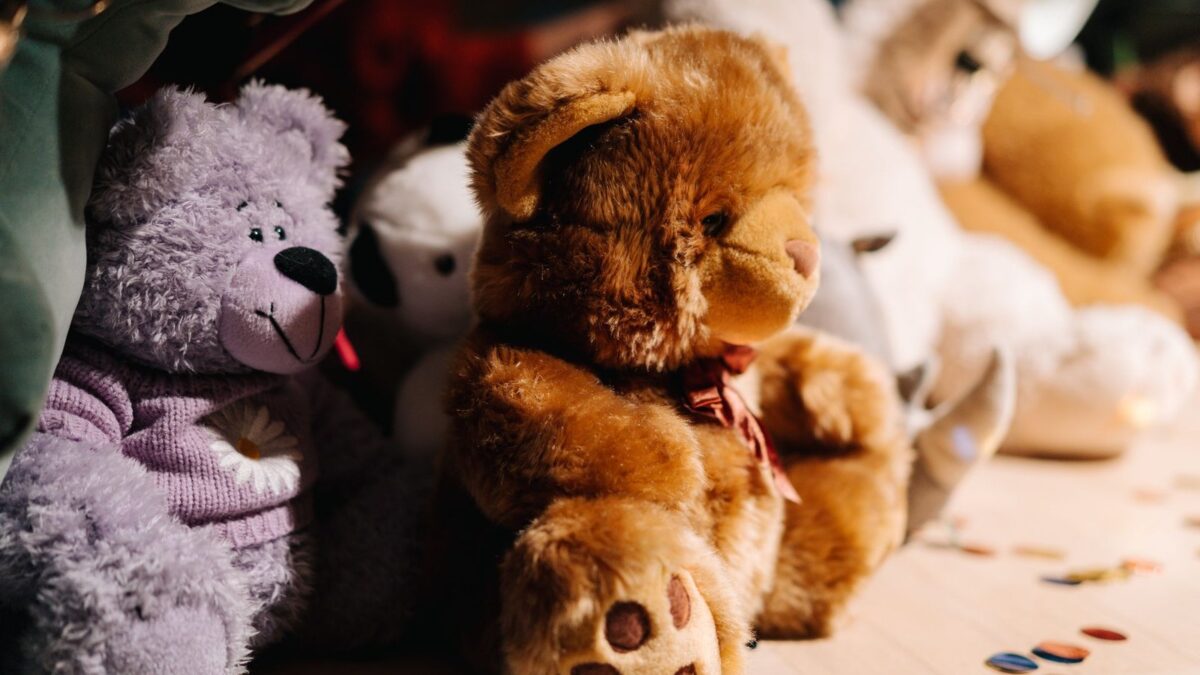
A vintage Gund teddy bear is easiest to date from the company name printed on its label. Gund changed hands several times after 1898, and each owner left a different name on paperwork, patents, and tags.
This guide follows those names through the patent record and museum catalogs. Our directory of popular plush brands gives Gund a short entry beside Steiff and Ty, so here we stay with one company and go deeper.
Gund History Before the Famous Bears
Adolf Gund and a disputed starting point
Every account agrees on 1898 and on a German immigrant named Adolf, sometimes spelled Adolph, Gund. The Strong National Museum of Play, home of the National Toy Hall of Fame and of Gund toys donated by Enesco, says he first sold artificial flowers, beads, and gifts before moving into soft toys.
The starting town is less settled. A 2016 Comics Kingdom history and a 2025 Toy Tales profile both place the early firm in Norwalk, Connecticut, with a move to New York City in 1922. Gund’s own patents complicate that story.
On a patent filed January 19, 1912, Adolf Gund describes himself as “a subject of the Emperor of Germany” and a resident of the Bronx, New York City. That proves where he lived in 1912, not where his workshop stood. Collectors who see “Connecticut” on a dealer’s provenance note should know the record is mixed.
The patents in Adolf Gund’s name
Gund’s early patents are not teddy bears. They are moving toys, which says a lot about what the young company sold:
- 1912: “Animated toy,” a wheeled animal such as a dog or duck that moves and makes a sound when pulled, US 1,032,205.
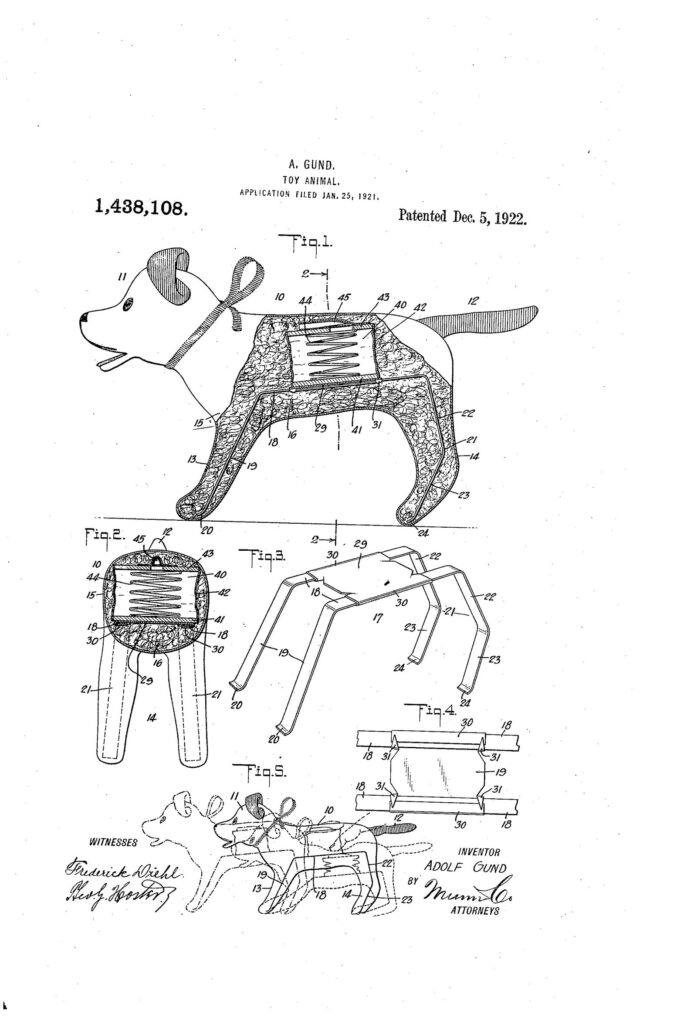
- 1922: “Toy animal,” designed to crouch and then jump forward when pressed and released, US 1,438,108.
- 1926: “Walking toy,” which imitates walking without clockwork or springs, US 1,576,435.
Jacob Swedlin takes over
The Strong says Gund hired Jacob Swedlin, a 12-year-old Russian immigrant, to work in the mailroom in 1907. When Gund retired, Swedlin bought the company, and it stayed a Swedlin family business until Enesco purchased it in 2008.
Most histories date the sale to 1925, and Toy Tales adds that Swedlin promised to keep the Gund name. That promise matters for dating, because the Gund name survives on tags across every later owner.
How Do You Date a Gund Teddy Bear?
You date a Gund teddy bear by reading the company name and address on its label, then checking that the construction fits the same decades. A tag naming J. Swedlin points to the Swedlin family era, while a tag naming Enesco or Spin Master points to 2008 or later. Construction then confirms or contradicts what the tag claims.
The table below uses only documented names and dates. We left out tag colors and logo styles that collectors circulate without a primary source.
| Era | Who ran Gund | Documented name or place | Evidence |
|---|---|---|---|
| 1898 to 1925 | Adolf Gund | Patents filed in his own name, Bronx, New York | Google Patents |
| 1925 to 1960s | Jacob Swedlin | Patents filed by Jacob Swedlin from Brooklyn and Rockville Centre, New York, 1941 to 1964 | Google Patents |
| 1964 | Jacob Swedlin | “J. Swedlin, Inc., Brooklyn,” as assignee | US Design 200,108 |
| 1969 onward | Herbert Raiffe, Swedlin’s son-in-law | Company president from 1969, as reported by Toy Tales | Toy Tales |
| 2008 to 2018 | Enesco | Gund as an Enesco division | The Strong |
| 2018 onward | Spin Master | Acquisition announced March 2018 | Spin Master |
Construction Clues From Swedlin’s Patents
Jacob Swedlin filed a run of design patents for stuffed toys between 1941 and 1948. Several are titled “Mask for stuffed toys or similar article,” which points to separately molded faces on some of his stuffed toys, the approach behind the vintage rubber faced teddy bear. A design patent shows only the look of a product, so it cannot tell you which toy reached the shelf.
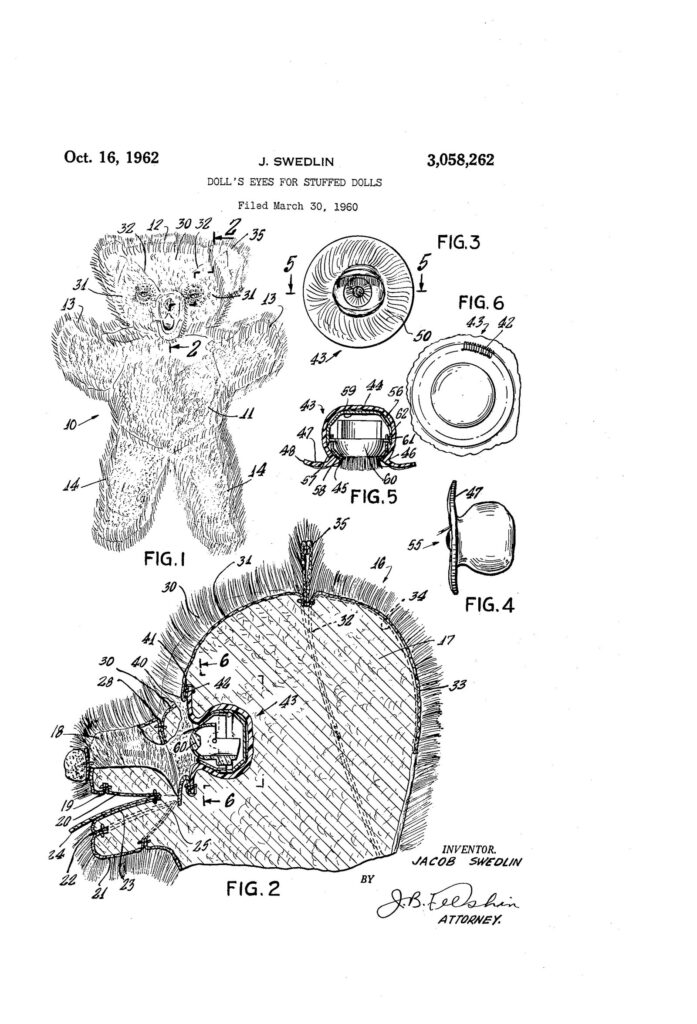
His 1960 utility patent is more useful for bears. It names “Teddy Bears and the like stuffed dolls” and describes eye sockets “made of soft resilient rubber-like plastic,” each holding an eyeball that rotates in a cage. Granted in 1962, it gives a firm earliest date for that eye design.
We cover the wider shift from glass and boot-button eyes to plastic in our piece on stuffed animal evolution throughout the years. For a Gund bear, the practical test is narrower: rotating plastic eyes in soft sockets should not appear on a bear sold as pre-war.
Photograph both sides of the label before you wash, mend, or sell the bear. The company name and address are the strongest evidence a Gund toy carries, and faded print is easier to read in a photo than on worn cloth.
Licensed Characters and a Disputed Disney Date
Gund made many licensed characters, and this is where dates get repeated without checking. The Comics Kingdom history says Gund “signed a license with the Walt Disney Studios” in 1947. Toy Tales dates Gund’s licensing of characters such as Mickey Mouse and Pluto to the 1960s instead.
We found no license document that settles it. The museum record we could verify is a Gund “Laughing Popeye” doll at The Strong, dated 1960 to 1965, with rights credited to King Features Syndicate. Treat any Disney-licensed Gund dated to the late 1940s as a claim to check, not a fact.
The 1948 Gund Bear on a Stamp
The best-known vintage Gund teddy bear may be one that appeared on postage. In 2002, the U.S. Postal Service issued four 37-cent Teddy Bears stamps, released August 15 at the American Philatelic Society’s show in Atlantic City.
The Associated Press listed the four bears as the Ideal Bear (1905), Bruin Bear (1907), Stick Bear (1920s), and Gund Bear (1948). That 1948 date is the stamp program’s description, so it fixes one Gund design to the late Swedlin years.
Reading Gund Vintage Stuffed Animals as a Set
Gund kept its name through every sale, so the brand alone never dates a toy. Read the owner’s name, the address, and the construction together, and let the oldest-looking feature be the one that needs proof.
The Enesco years link Gund to a wider giftware business, the same company behind the resin bears in our guide to dating Cherished Teddies winter figurines. The open question is whether Gund’s own business records will ever be published in enough detail to put firm dates on the labels themselves.
Sources
- The Strong National Museum of Play, “Character doll: Laughing Popeye Doll,” GUND, 1960–1965, 115.1062, via Google Arts & Culture, artsandculture.google.com.
- The Strong National Museum of Play, “Doll: Baby Doll,” GUND, 1950–1959, 115.1337, via Google Arts & Culture, artsandculture.google.com.
- Adolf Gund, “Animated toy,” US Patent 1,032,205, 1912, patents.google.com.
- Adolf Gund, “Toy animal,” US Patent 1,438,108, 1922, patents.google.com.
- Adolf Gund, “Walking toy,” US Patent 1,576,435, 1926, patents.google.com.
- Jacob Swedlin, “Stuffed toy or similar article,” US Design Patent 131,827, 1942, patents.google.com.
- Jacob Swedlin, “Doll’s eyes for stuffed dolls,” US Patent 3,058,262, 1962, patents.google.com.
- Jacob Swedlin, assignor to J. Swedlin, Inc., “Eye for toy animal or similar article,” US Design Patent 200,108, 1965, patents.google.com.
- Spin Master, “Spin Master Announces Acquisition of GUND from Enesco,” 2018, spinmaster.com.
- Todd Coopee, “Gund,” Toy Tales, 2025, toytales.ca.
- Comics Kingdom, “Hand Puppets,” 2016, comicskingdom.com.
- Syd Kronish, Associated Press, “Teddy bears,” Lawrence Journal-World, July 28, 2002, www2.ljworld.com.

Comments (0)