
Two workshops have a fair claim on who invented teddy bears. In Brooklyn, Rose and Morris Michtom sold a stuffed “Teddy’s Bear” after Roosevelt’s 1902 bear hunt made the news. In Giengen, Germany, Richard Steiff designed a jointed plush bear that his family firm put into production.
They worked within months of each other, an ocean apart, from two separate starting points. Both stories start from the 1902 Mississippi hunt and its aftermath, which we cover separately.
The question here is narrower. What does each side’s evidence actually prove, and who deserves the credit when the paper trail runs out?
The Case for Rose and Morris Michtom
The Michtoms ran a candy shop in Brooklyn, New York. After the couple saw Clifford Berryman’s cartoon of the hunt, Rose sewed two stuffed bears to sell there, according to the National Park Service.
The bears sold, and the couple kept making them. Their toy carried Roosevelt’s name from the first day, a detail we trace in our piece on how “Teddy’s bear” got its name.
What the records support
The Michtom claim rests on three kinds of evidence. Each one is real, but each comes with a date or a source attached:
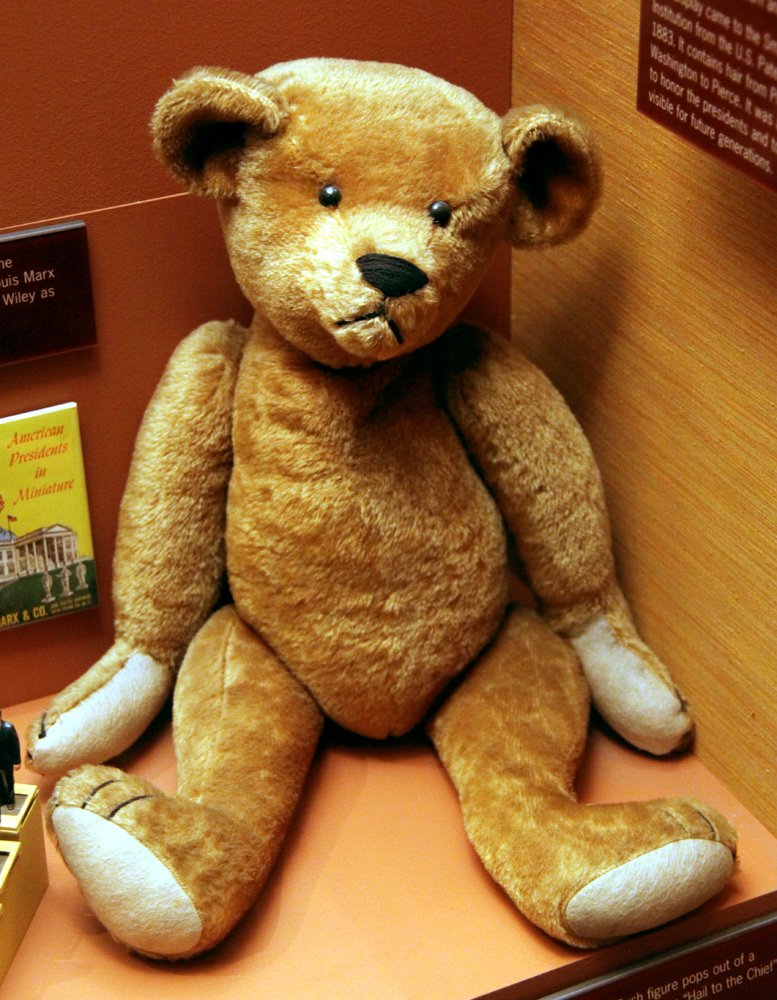
- A dated object. The Smithsonian’s National Museum of American History holds an Ideal Toy Company bear catalogued as made about 1903.
- A company. The National Park Service and the Smithsonian both date the founding of the Ideal Toy Company to 1903.
- A family account. The Smithsonian records the recollection of Benjamin Michtom, the couple’s son, that Roosevelt agreed to the use of his name.
Where the Michtom evidence is thin
The famous permission letter is missing. The Theodore Roosevelt Presidential Library says Michtom family tradition describes the request, but no such letter has ever been found.
The company date also wobbles. That same library says the Michtoms founded the Ideal Novelty and Toy Company in 1907. The Park Service and the Smithsonian both give 1903.
None of the shop’s first two bears is known to survive. The Smithsonian bear is dated “about 1903,” so it cannot prove a 1902 start on its own.
The Case for Richard Steiff
Steiff was already a working toy company when the bear craze began. The firm dates its founding to 1880, when Margarete Steiff sewed a felt elephant from a pattern in a fashion journal.
Her nephew Richard joined in 1897. According to the BBC, he had sketched bears at the Stuttgart zoo while studying art, and those drawings shaped his first lifelike toy bear.
The Bear 55 PB
Steiff’s corporate timeline says Richard designed the Bear 55 PB in 1902, using mohair plush from the Schulte mill in Duisburg. The BBC explains the code: 55 for its height in centimeters, P for plush, and B for “beweglich,” German for movable.
“Richard Steiff designs the ‘Bear 55 PB’, the world’s first plush bear with movable arms and legs.”
Margarete Steiff GmbH, company timeline entry for 1902
The design reached buyers at the Leipzig Toy Fair. An American dealer ordered 3,000 bears, and the BBC names him as Hermann Berg, a buyer for George Borgfeldt & Company of New York.
Where the Steiff evidence is thin
No 55 PB is known to survive. The BBC reports that Steiff’s archive holds the orders and samples of the boxes. None of the 3,000 bears has turned up.
The date is disputed too. Steiff files the bear and the Leipzig order under 1902. The BBC places the fair in the spring of 1903. The “world’s first” wording is the company’s own claim about its own product.
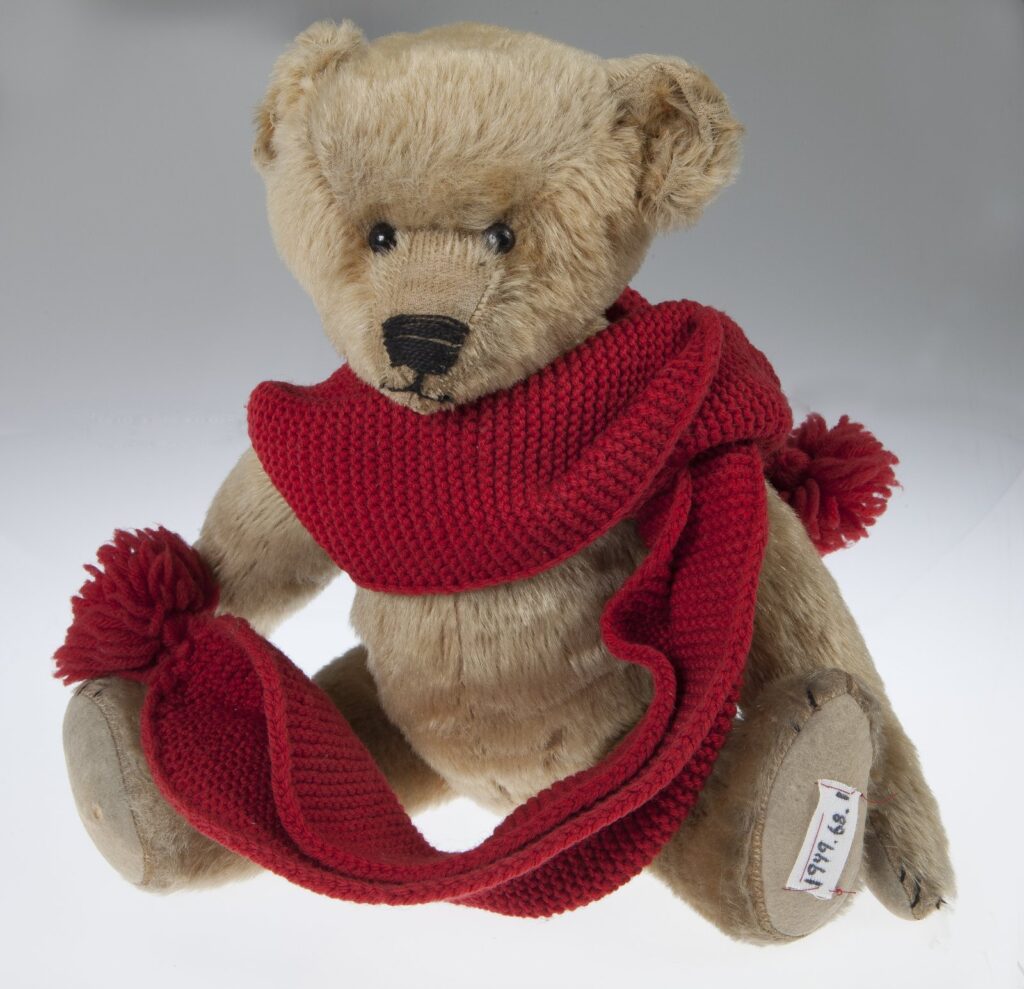
The oldest Steiff bears in public collections come slightly later. The Missouri Historical Society holds a beige mohair Steiff bear dated between 1904 and 1905, with felt pads and shoe button eyes.
Who Made the First Teddy Bear?
No surviving object or dated document settles who made the first teddy bear. The Michtoms were most likely first to sell a stuffed bear under Roosevelt’s name, in late 1902 or 1903. Richard Steiff was first to design a jointed plush bear for factory production. Steiff dates that design to 1902, and the BBC dates its debut to 1903.
The two claims answer different questions. Laid side by side, the gaps become easier to see:
| Evidence | Rose and Morris Michtom | Richard Steiff |
|---|---|---|
| Place | Brooklyn, New York | Giengen, Germany |
| Earliest date claimed | Late 1902 | 1902 (Steiff) or spring 1903 (BBC) |
| Key document | Family account of Roosevelt’s permission; no letter found | Steiff order records for 3,000 bears |
| Earliest surviving bear | Ideal bear, about 1903 (Smithsonian) | Steiff bear, 1904 to 1905 (Missouri Historical Society) |
| Name at launch | “Teddy’s Bear” | Bear 55 PB; “Teddy” linked in 1906, per Steiff |
| Weak spot | Founding year given as 1903 or 1907 | No 55 PB survives |
Our Verdict on the Teddy Bear Invention
Credit both, but for different things. The Michtoms invented the teddy bear as a named American toy, because their bear carried Roosevelt’s name from the start. Steiff invented the jointed mohair plush bear that most collectors now treat as the standard form.
If the question demands one answer, we give it to the Michtoms. The word “teddy” is what separates a teddy bear from any other toy bear. Steiff’s own timeline does not attach that name to its bears until 1906.
Steiff wins on documentation. Its order records exist, its factory scaled up quickly, and its surviving bears are better dated than anything from the Brooklyn shop’s first months.
Treat any listing for “the first teddy bear” with suspicion. Neither of Rose Michtom’s first two bears nor any 55 PB is known to survive. The earliest documented examples date to about 1903 for Ideal and 1904 to 1905 for Steiff.
The invention question stays open only because two bears went missing. If a 55 PB or a dated Brooklyn bear ever surfaces, the credit could shift with it.
Sources
- National Park Service, Theodore Roosevelt Birthplace, “The Story of the Teddy Bear,”, nps.gov.
- National Park Service, Theodore Roosevelt Inaugural Site, “Teddy Bear History,”, nps.gov.
- Smithsonian National Museum of American History, “Teddy Bear,” ca. 1903, PL.252493.02, si.edu.
- Theodore Roosevelt Presidential Library, “Top 10 Myths about Theodore Roosevelt and the Invention of the Teddy Bear,”, trlibrary.com.
- Theodore Roosevelt Presidential Library, “Did Roosevelt Like Being Called ‘Teddy’?”, trlibrary.com.
- Margarete Steiff GmbH, “From the past to the present,”, corporate.steiff.com.
- BBC News, “The great teddy bear shipwreck mystery,” 2011, bbc.com.
- Missouri Historical Society, “Steiff Teddy Bear,” 1904 to 1905, object 1949-068-0001, collections.mohistory.org.
1 thought on “Who Invented Teddy Bears Depends on What You Count”