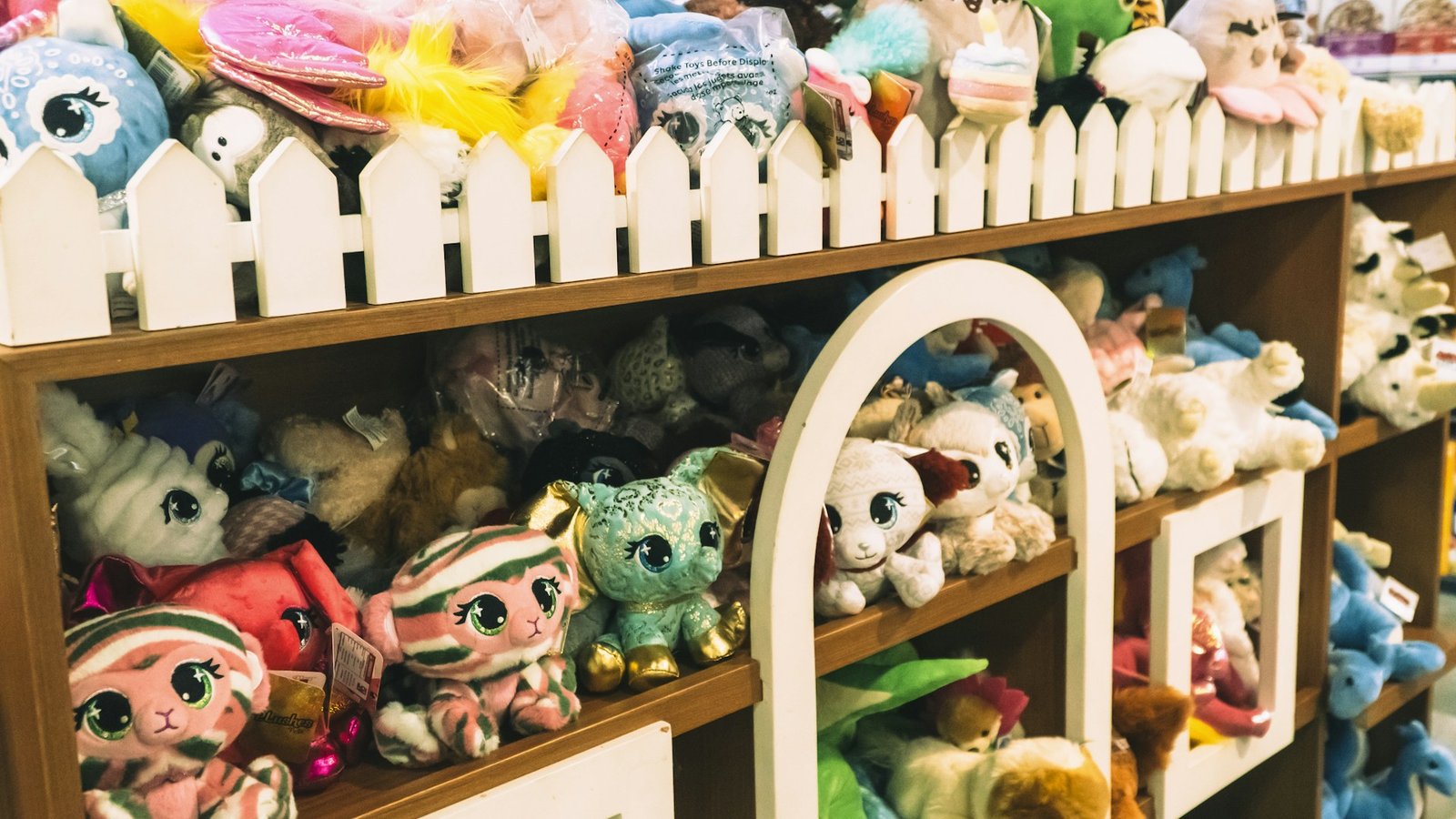
Six popular plush brands come up again and again in collector conversations: Steiff, Hermann, Merrythought, Gund, Ty, and Jellycat. Each one marks its toys differently, and those marks are the fastest way to tell a real piece from a copy.
This directory covers where each maker started, what collectors look for, and which tag or button to check first. For the toy that started the whole trade, see our history of the teddy bear from the 1902 hunt onward.
Popular Plush Brands at a Glance
These famous plush brands span three centuries of production. The table lists founding dates as each company or its records state them. Where two sources disagree, the brand’s own section below explains the gap.
| Brand | Founded | Home | First mark to check |
|---|---|---|---|
| Steiff | 1880 | Giengen, Germany | Metal “Button in Ear” with ear tag |
| Teddy-Hermann | 1912 | Sonneberg, now Hirschaid, Germany | Company label and tag |
| Hermann Coburg | 1913 or 1920 | Neufang, now Coburg, Germany | Green triangle logo, from 1933 |
| Merrythought | 1930 | Ironbridge, England | Woven label; wishbone motif from 1991 |
| Gund | 1898 | United States | Gund label and tag |
| Ty | 1986 | Oak Brook, Illinois | Heart-shaped hang tag |
| Jellycat | 1999 | London, England | Brand label; bought from an authorized stockist |
What Is the Most Popular Brand of Stuffed Animals?
No public ranking settles the question, because the private companies involved do not publish comparable sales figures. The fair answer depends on what “popular” means: Steiff for history, Ty for the size of its collecting boom, and Jellycat for current retail reach.
Each of those claims rests on a different kind of evidence. Steiff can point to the oldest continuous production. Ty says Beanie Babies made it the world’s largest maker of stuffed plush toys, and Jellycat reports sales through stores in 77 countries.
The German Makers
Steiff
Margarete Steiff’s company dates its founding to 1880 and still works from Giengen an der Brenz. Its claim on the teddy bear rests on Richard Steiff’s jointed Bear 55 PB of 1902. We weigh that claim against the Michtoms’ in the debate over who invented teddy bears.
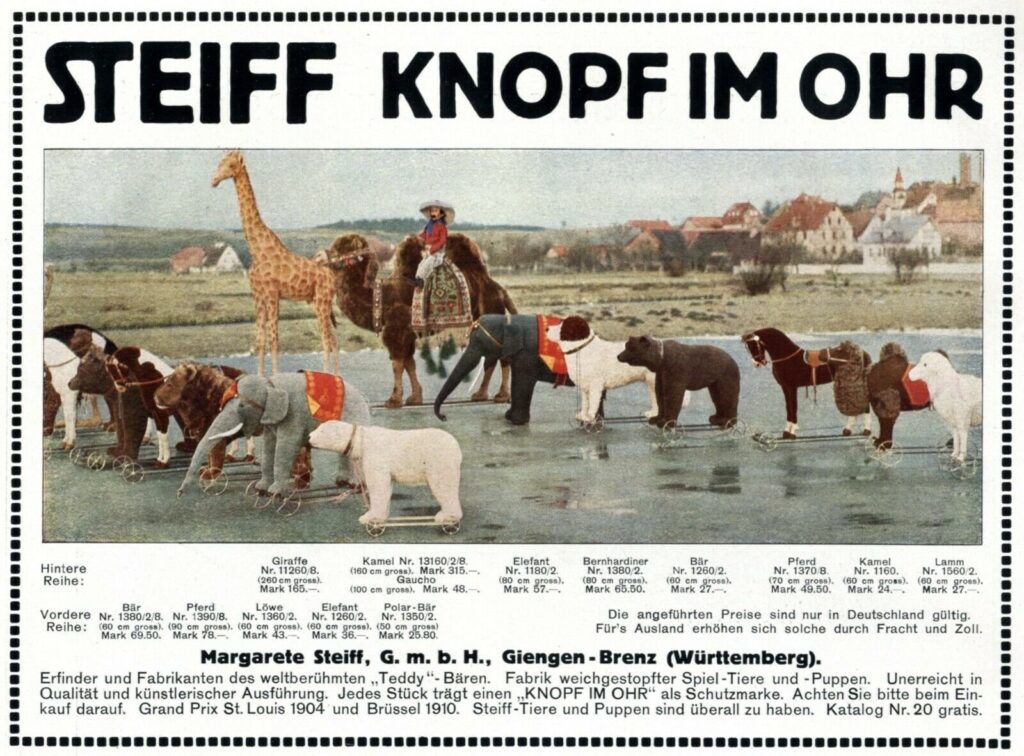
Steiff told buyers to check for its trademark more than a century ago. A 1913 advertisement calls the company the inventor of the “Teddy” bear and asks shoppers to look for the “Knopf im Ohr,” the button in the ear, when buying.
The button still does that job, and today the ear tag behind it carries extra information. According to Steiff’s guide to its ear tags, the color tells you which line a toy belongs to:
- Yellow tag: the current children’s range, which Steiff calls Friends.
- White tag with red lettering on a gold-plated button: limited editions for adult collectors.
- White tag with blue lettering on a brass button: open, unlimited collector editions.
A button alone does not date a Steiff. The earliest buttons carried an elephant before the company switched to “Steiff” lettering. Match the button style to the claimed era before paying an antique price.
Hermann: two companies, one family name
Collectors often lump “Hermann” bears together, but the name covers two separate firms. Both carry the name of a toy-making family from the Sonneberg area, then a center of the German toy trade.
Teddy-Hermann says Bernhard Hermann founded it in Sonneberg in 1912 under the name “BE HA,” from his initials. The company moved to Hirschaid near Bamberg in 1948 and still makes limited collector bears there.
Hermann Coburg tells a different start date. Its history says siblings Arthur, Adelheid, and Max Hermann made their first teddy bear in Neufang on October 24, 1913. Max set up his own company in 1920, introduced a green triangle trademark in 1933, and moved to Coburg in 1953.
The practical rule is simple. A “Hermann” listing without a photo of the mark could be either company, and the green triangle points to the Max Hermann line.
The British Maker
Merrythought
Merrythought began in 1930, when William Gordon Holmes of the Yorkshire spinning mill Holmes and Laxton set up a soft toy factory in Ironbridge, Shropshire. The company says its first range was designed by Florence Attwood, a deaf pattern maker whose Merrythought and Magnet bears still shape its designs.

The name is an old English word for a wishbone. Merrythought’s labels changed with the decades, which makes them useful for dating:
- 1931: the first woven label, stating “Made in England.”
- Late 1950s: printed labels.
- 1991: new woven labels with the wishbone motif.
- Today: a simplified woven label in gold and black thread.
Merrythought also holds the archive of J.K. Farnell, an older British maker. The company says Farnell made the first British teddy bear in 1906 and that Farnell’s “Alpha” label passed to Merrythought after Farnell stopped trading in the late 1970s. That 1906 date is Merrythought’s account of a rival it later absorbed, not a settled record.
Farnell’s best-known bear is Edward, the toy Christopher Robin Milne received and A.A. Milne turned into Winnie-the-Pooh. We trace the Harrods bear that became Pooh in our list of teddy bear facts, and Merrythought still produces replicas from Farnell’s archive.
The American Makers
Gund
Gund’s own site says it has made plush since 1898 and calls itself the oldest soft toy manufacturer in America. Collector histories credit a German immigrant, Adolf or Adolph Gund, and split on whether he started in Connecticut or New York. The company’s history page names neither the founder nor the town.
Ownership changed in 2018. On March 5 that year, Spin Master announced it was buying Gund from Enesco and called it the oldest soft toy brand in the United States. Trade coverage put the price at about $79.1 million. The seller, Enesco, is the same company behind the resin bear figurines in our guide to Cherished Teddies winter pieces.
Ty
Ty Warner founded Ty Inc. in 1986 in Oak Brook, Illinois. Ty says its first products were lifelike Himalayan cats, and the Beanie Babies line followed in 1993.
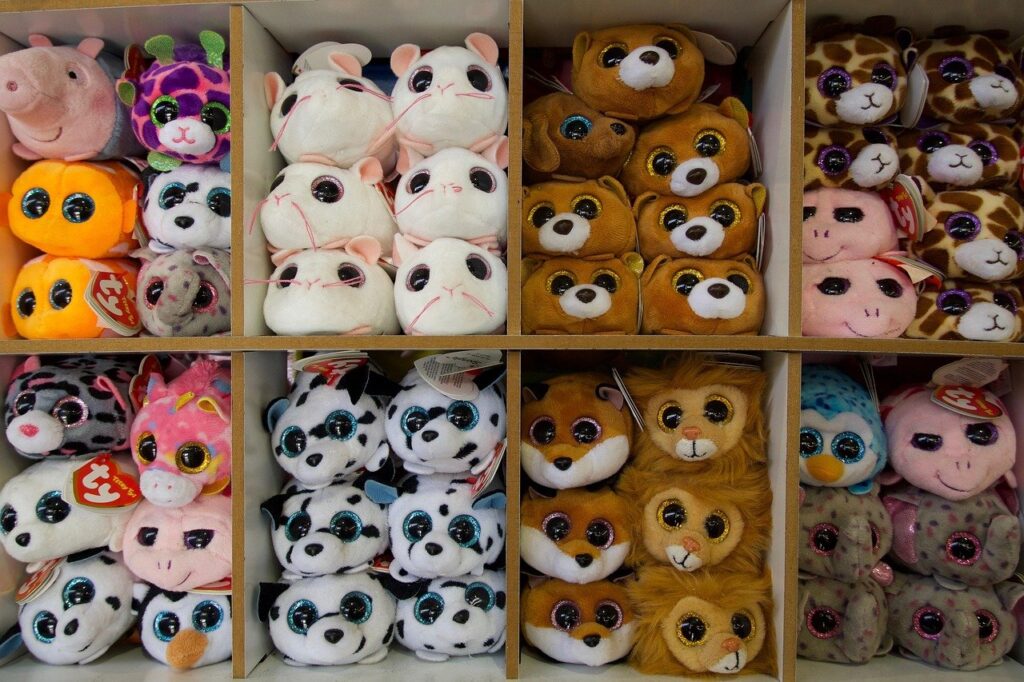
For collectors, the heart-shaped hang tag is the first thing to inspect. Ty says it printed its website address, ty.com, on those tags from 1995, which gives one rough dating clue for a Beanie Baby with its tag intact.
The Newer Name
Jellycat
Jellycat dates its start to London in 1999, and an MBS Group interview names its co-founders as brothers Thomas and William Gatacre. The company’s own website tells a playful version instead, crediting the “ninth generation of cat” with opening the Jellycat studios.
Jellycat’s brand protection statement is blunt about fakes. The company says it cannot authenticate counterfeit products after purchase. Buyers with doubts are pointed to its list of authorized stockists, which includes more than 1,200 independent stores in the UK alone.
How to Check Stuffed Animal Brand Names Before You Buy
Brand names are easy to print on a listing. The marks below are harder to fake well, and each maker has documented its own:
- Steiff: button in the ear plus a tag color that matches the claimed line.
- Hermann: which Hermann, and whether the mark is the green triangle.
- Merrythought: label style that fits the claimed decade.
- Ty: an intact heart-shaped tag, with the website line only on tags from 1995 onward.
- Jellycat: purchase from a stockist on the company’s own locator.
None of these checks proves age by itself. They narrow the field, and a seller who cannot show the mark clearly has told you something useful already.
Sources
- Margarete Steiff GmbH, “From the past to the present,” corporate.steiff.com.
- Margarete Steiff GmbH, “Button in Ear,” corporate.steiff.com.
- Steiff, “Steiff ‘Button in Ear’ Tags,” steiff.com.
- Teddy-Hermann, “Company History,” teddy-hermann.de.
- Hermann Coburg, “The HERMANN Coburg History,” hermann.de.
- Merrythought, “Our Story,” merrythought.co.uk.
- Merrythought, “The History of the Merrythought Label,” merrythought.co.uk.
- GUND, “History,” gund.com.
- Spin Master, “Spin Master Announces Acquisition of GUND from Enesco,” 2018, spinmaster.com.
- Ty Inc., “Ty Classics: The Original 9 Beanie Babies,” ty.com.
- Ty Inc., “5 Fun Facts About Beanie Babies,” ty.com.
- License Global, “Spin Master Acquires Gund,” 2018, licenseglobal.com.
- The MBS Group, “Making beautiful things that people remember: in conversation with William Gatacre,” 2021, thembsgroup.co.uk.
- Jellycat, “Our Story,” jellycat.com.
- Jellycat, “Brand Protection Statement,” jellycat.com.
- Jellycat, “Find a Stockist,” jellycat.com.
- Margarete Steiff GmbH, “Steiff ear tags,” steiff.com.
2 thoughts on “Popular Plush Brands Worth Collecting and How to Spot Fakes”